Archive for the ‘Crypto creatures’ Category
Saturday, January 24th, 2015
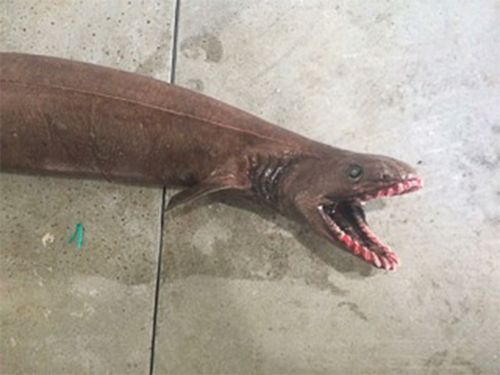
That nightmarish thing in the photo above isn’t a screen-used graboid prop from Tremors.
Nope.
That’s an actual creature that lives in our oceans…you know…that giant mass of water that you swim in when you vacation?
Caught off the coast of Australia by a fishing trawler, that thing is a six-foot long monster known as a frilled shark.
Frilled sharks haven’t evolved in almost 80 million years simply because a nightmare is always going to be a nightmare. On very rare occasions frilled sharks are found close to the surface because they’re dying. “Close to the surface” is around 4,000 feet below the surface.
Simon Boag of the trawling company that caught the creature:
“It does look 80 million years old. It looks prehistoric. It looks like it’s from another time! It has 300 teeth over 25 rows, so once you’re in that mouth, you’re not coming out.”
According to a marine conservation society in California there is a report of a frilled shark from 1880 measuring in at 25 feet.
Next time you go splashing around in the ocean for fun just remember…
These live there.
[NatGeo]
Posted in Animal, Creature, Creepy, Cryptid, Crypto creatures, cryptozoology, Deep Ocean, Dinosaur, Fish, Monster, Ocean, Sea Creature, Sea Monster, Shark, Weird Animals | Comments Off on Nightmare Shark Caught Off Coast of Australia – Has Been Terrifying World for 80 Million Years
Friday, November 14th, 2014
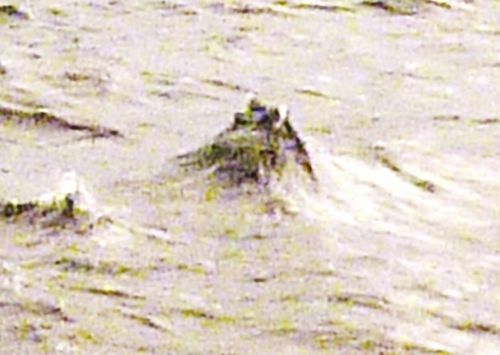
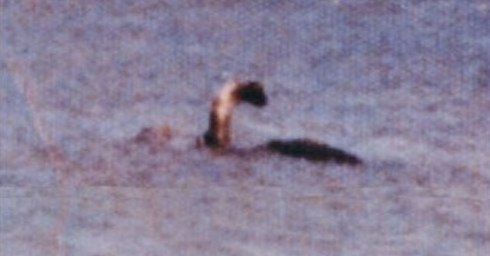
Jonathon Bright, a paranormal investigator who’s started adding ‘Monster Hunter’ to his resume – because who WOULDN’T want ‘Monster Hunter’ on their resume – has started sharing a photo that might be the famous camera-shy creature that has become legendary.
“Three years ago, I came to Scotland to investigate the Nessie legend and took thousands of photographs. It took me six months to look at them all and I found this one which I showed when I spoke at the Scottish Paranormal Festival in Stirling this week. After I had finished there, I came north to spend more time searching for an answer to the Nessie story. My picture is a talking point. Some people will say it is physical and the monster, others will say it is a trick of the water, others will say it is a hoax.”
It would be great if this was in fact the mysterious animal that everyone says lives in the Loch.
It would be even greater if a professional photographer with ninja-like focusing skills and a decent camera would add “Monster Hunter’ to their resume.
[The Scotsman]
Posted in Cryptid, Crypto creatures, cryptozoology, Lake Monster, Loch Ness, Loch Ness Monster, Monster, monster mystery, Monster Sighting, Sea Creature, Sea Monster | Comments Off on Monster Hunter claims this is the Loch Ness Monster – Looks remarkably like…whatever you want it to be
Sunday, August 11th, 2013
Recently a company called Legend Tracker, that’s created an augmented reality adventure application, put out a call for video submissions to anyone who had footage of what they thought might be everyone’s favorite, but annoyingly elusive, cryptid…Bigfoot.
They’ve done this before…but this time, after sifting through hundreds of submissions, two crazy videos have come out on top.
The first video is from a couple hiking in the area of Mission, British Columbia. While shooting some scenery, they noticed something moving on a hilltop nearby. Is it bigfoot, Rob Zombie on a nature walk or just a feral Kardashian?
That first video is your typical “I spotted Bigfoot!” video…however…the video below, shot by a group of tourists, is probably the weirdest video of an alleged sasquatch because we’re not sure what’s going on in it.
It was sent in as a submission for Bigfoot footage but it looks more like someone’s drunk, hairy, mountain-man uncle who just dropped his moonshine jug or possibly Chaka from the original Land of the Lost. At the end of the video the alleged bigfoot appears to threaten or make a move toward the tourist because everyone starts running around like frightened Muppets. This video was also shot in the Mission, British Columbia area.
[Metro Co UK]
Posted in Bigfoot, Cryptid, Crypto creatures, cryptozoology, Monster Sighting, Sasquatch | Comments Off on Sasquatch Sightings in British Columbia!
Monday, October 15th, 2012

Russia has become a hotbed of Yeti activity over the last couple of weeks. And what’s more awesome than seeing a Yeti?
Seeing a group of Yeti.
In those last couple of weeks the sightings of Bigfoot’s Siberian cousin, two have included multiple Yeti hanging out together.

Sighting #1:
“We shouted, ‘Do you need help?’ They rushed away, all in fur, walking on two legs, making their way through the bushes and with two other limbs, straight up the hill. The person who made the report added: “It could not be bears, as the bear walks on all fours, and they ran on two. Then they were gone.”
Sighting #2:
“We saw some tall animals looking like people. Our binoculars were broken and did not let us see them sharply. We waved at the animals but they did not respond, then quickly ran back into the forest, walking on two legs. We realized that they were not in dark clothes but covered by dark fur. They did walk like people.”
Sighting #3:
A forestry inspector reported seeing a yeti in a national park, a government official said. Sergei Adlyakov, the inspector who reported the incident said: “The creature did not look like a bear and quickly disappeared after breaking some branches off the bushes.”
Are Yeti growing in number? Have they just gotten numb to the whole ‘being spotted’ thing? Only one man may know the answer because he’s Russia’s Yeti expert. Igor Burtsev is the head of the International Center of Hominology and is very excited to learn more about the recent blossoming of Yeti activity. Burtsev also claims that there is an active population of about 30 of the creatures living in the Kemerovo region of Russia.
He said: “We have good evidence of the yeti living in our region, and we have heard convincing details from experts elsewhere in Russia and in the U.S. and Canada.
[Fox News]
Posted in Abominable Snowman, Animals, Bigfoot, Cryptid, Crypto creatures, cryptozoology, Monster Sighting, Russia, Sasquatch, Yeti | Comments Off on Multiple Yeti Sighted In Russia!
Tuesday, August 28th, 2012
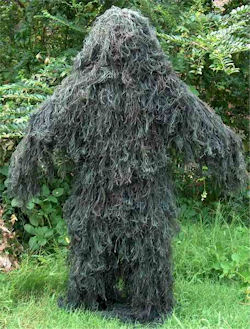
“How’d your uncle die?”
“He was dressed like a sad, ghetto version of bigfoot, walked into traffic and got nailed by two oncoming cars.”
True story.
44-year-old Randy Lee Tenley of Montana was struck dead when he was hit by two oncoming vehicles as he attempted to cross several lanes of traffic dressed like more like a topiary at a bankrupt garden attraction than Bigfoot in hopes he’d stir up some sightings of the infamously mysterious legend.
Police are continuing their investigation to see if alcohol played a role in the incident.
We’re going to go with, “Yes. There was a LOT of alcohol that a role in the incident.”
What kind of epitaph would you write for that?
[ABCNews.com]
Posted in Bigfoot, Crypto creatures, cryptozoology, Drunk, Sasquatch, Yeti | 3 Comments »
Thursday, January 19th, 2012
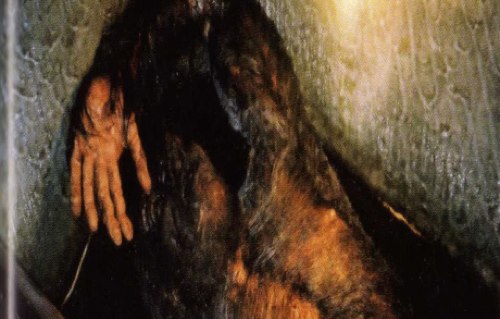
Here are new pictures of the historic Minnesota Iceman, a curiosity which circulated through carnivals and fairs through the 1960s. As you can see, the creature has a arm out stretched over his face which, if you can squint, appears to only feature one eye in socket.
The pictures appear in a new book entitled Pickled Punks and Girlie Shows by Rick West.
[Cryptomundo]
Posted in Crypto creatures | Comments Off on The Minnesota Iceman Shields His Eye
Friday, July 23rd, 2010

Special guest Dr. Karen Stollznow helps the gang plan a heist for a sacred Yeti paw. Brian and Justin get enormous glee from watching Andrew get corrected. The ethics of eating canned whale meat is debated. We also find out how ready and willing we are to be corrupted by the dark side.
Then a super secret plan (shhhh!) is hatched to get prominent skeptics tripped out on psychoactives so we can see what happens when they have their own double rainbow experience.
Subscribe to the Weird Things podcast on iTunes
Podcast RSS feed
Episode archive
Download url: http://www.itricks.com/upload/WeirdThings072110.mp3
Dr. Karen Stollznow’s website
[podcast]http://www.itricks.com/upload/WeirdThings072110.mp3[/podcast]
Posted in Crypto creatures, cryptozoology, Podcast, Podcasts, Yeti | 7 Comments »
Sunday, June 6th, 2010
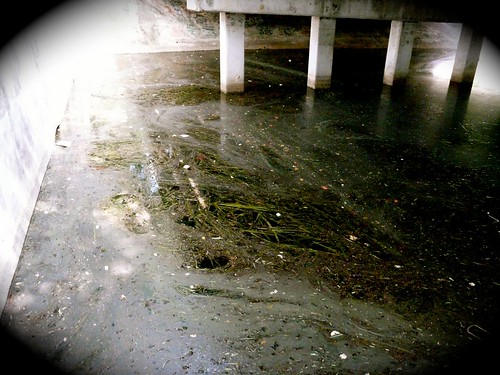
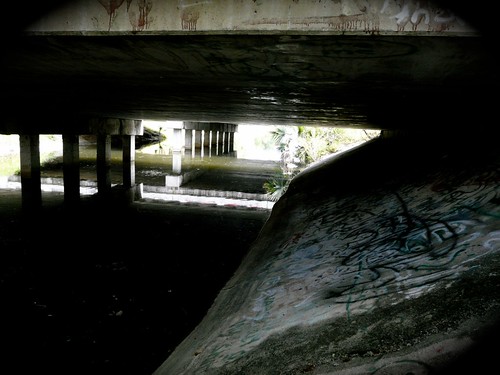
As we prepare for tomorrow’s live hunt for what is known as the “Night Creeper”, we thought we’d share with you some photos from a recent reconnaissance of the area. Our first nighttime recon resulted in Justin and I getting stopped by the police FYI. It appears we’re not the only ones paying attention to the weird reports coming from the area.
What stood out most to us is the fact that this area forms a triangle with two other hotspots of unusual activity and they both have large bodies of water nearby that lead straight to the Everglades – a wild environment filled with cryptid and unusual phenomena.
On Monday night’s live show (9PM EST) we plan to go into a tunnel that’s the main access point between the wetlands and the area of interest. We’re not assuming it’s a cryptid or some other creature that’s been sighted. We just find it very interesting.
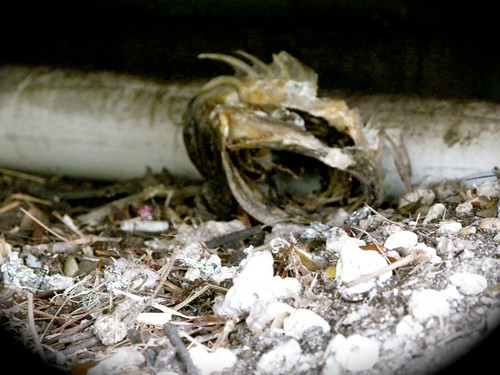
During our daylight investigation we found signs that something was living underneath there or at least spent some time there. The above photo shows a very large fish head that was dragged 10 feet above the bank into a dark corner. A raccoon or Gollum? We hope to find out.
Posted in Andrew Mayne, Crypto creatures, cryptozoology, Ghost Hunting | 8 Comments »
Wednesday, April 14th, 2010
Cryptomundo tells the beautiful love story of actress Maria Bello (you might remember her from THAT scene in A History Of Violence) and her new fiance Bryn Mooser, one that was cemented by a mutual interest in the search for cryptids.
Other common interests? Politics and Africa.
[Cryptomundo]
Posted in Crypto creatures, cryptozoology | Comments Off on Maria Bello Lists Cryptozoology Among Common Interests With New Fiance
Tuesday, April 13th, 2010

Many mistaken cryptids are actually just fugly animals with a bad case of the mange. So what does that have to do with our planet’s current case of global warming driving and increase in sightings of potential Yetis, Bigfoots and Chupacabra?
Everything.
LiveScience spoke to Mike Bowdenchuck, state director for Texas Wildlife Services, who explained why mysterious, hairless animals are more common in Texas and the southwest than other areas:
“Down here, animals don’t die of mange, because the temperatures are warm enough,” Bowdenchuck said. Rather, the animals live with mange.
“Mange is very common in colder areas, in fact wolves are getting it in Montana right now, and in North Dakota foxes get it,” he said, noting a big difference: “Up there it’s fatal, so you never see animals with the severe cases that we see in the southern climates, because they don’t live long enough for the mites to get that bad to cause the hair to fall off. They die of hypothermia first.”
Animals that have lost their fur are more vulnerable to the cold, so in warmer climates they live longer (and be more likely to be seen). Thus one might conclude that sightings of hairless animals will become more common as the climate warms. The extended forecast calls for more non-Bigfoot, non-Yeti, and non-chupacabra mangy monster sightings.
Why wasn’t this the poster for An Inconvenient Truth?
[Live Science]
Posted in Crypto creatures, cryptozoology | Comments Off on Can Increased Cryptid Sightings Be Blamed On Global Warming?
Friday, October 16th, 2009
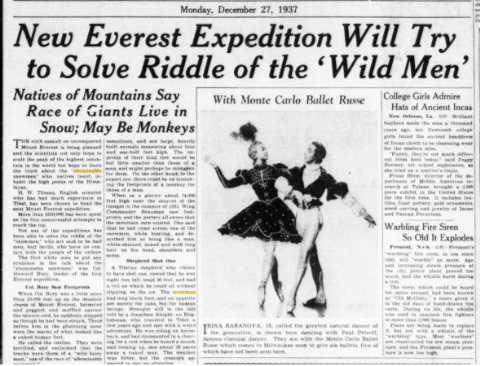 Over time fads and tastes change. You’d think that at least Yeti’s could remain immune to this kind of cultural pressure. Sadly no. His appearance and behavior has changed over the years.
From the December 27th, 1937 Milwaukee Journal, we have one of the earliest accounts ever of a Yeti.
When Col. Bury was a little more than 20,000 feet up on the desolate slopes of Mount Everest, helmeted against the intense cold, he suddenly stopped as though he had been struck. There before him in the glistening snow were the marks of what looked like a naked human foot.
He called the coolies. They were terrified, and exclaimed that the tracks were those of a “wild hairy man,” one of the race of “abominable snowmen.”
Black hair and a tail?
A Tibetan shepherd who claims to have shot one, vowed that he was eight feet tall, leapt 20 feet, and had a tail on which he could sit without slipping on the ice. The snowman had long black hair, and an appetite not merely for yaks, but for human beings.
Fans of lovable, white haired and perhaps only slightly grumpy Yeti’s will be disappointed to find out that back then they came across as more like cold loving cannibal naked meth heads then lonely Wampas wanting hugs from Jedis and the occasional Tauntaun jerky treat.
The Milwaukee Journal. – Google News Archive Search
Posted in Crypto creatures, Yeti | Comments Off on When Yeti’s were Abominable
Wednesday, October 14th, 2009
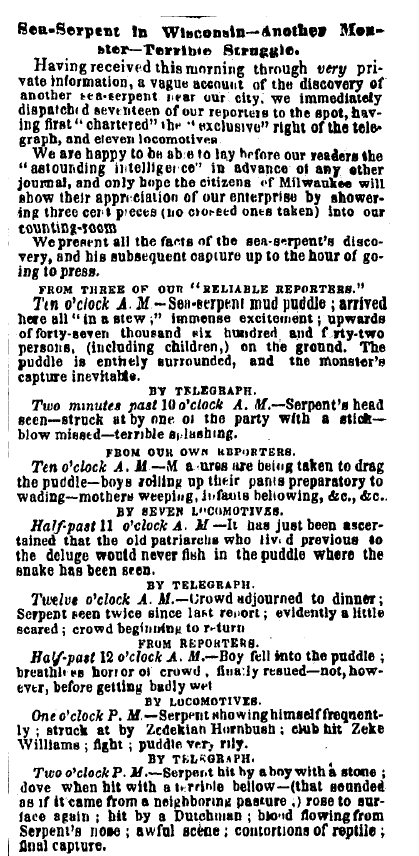
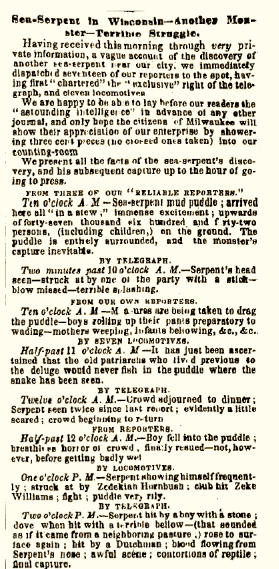
Sea Monsters are awesome. What’s even more awesome than that? Live blogging your investigation of said sea monster in 1855! How is that even possible? In 1855 the New York Times was on the cutting edge of tech journalism utilizing telegraphs and locomotives to report the news live from the scene:
Having received this morning very private information, a vague account of the discovery of another sea-serpent near our city, we immediately dispatched seventeen of our reporters to the spot, having first “chartered” the “exclusive” right of the telegraph, and eleven locomotives.
By securing an communications connection via telegraph, reporters were able to send back a blow-by-blow account of their investigation as it unfolded.
Two minutes past 10 o’clock A.M – Serpent’s head seen – struck at one of the party with a stick – blow missed – terrible splashing.
One o’clock P.M. – Serpent showing himself frequently; struck at by Zedekiah Hornbush; club hit Zeke Williams; fight; puddle very rily.
Two o’clock P.M. – Serpent hit by a boy with a stone; dove when hit with a triple bellow – (that sounded as if it came from a neighboring pasture,) rose to surface again; hit by Dutchman; blood flowing from Serpent’s nose; awful scene; contortions of reptile; final capture.
What was this mysterious creature that Zedekiah and Zeke fearlessly confronted with their clubs? The report doesn’t quite get into specifics other than to say it may be of the “Garter” species – which suggests that it’s what we call a Garter snake today. They point out that there is no doubt he was in some relation to the Serpent that tempted Eve, “as he looks very wicked”. Wicked indeed. Remember this was four years before Darwin published The Origin of Species.
The story is a fascinating read and well worth checking out: Sea-Serpent in Wisconsin–another Monster–Terrible… – View Article – The New York Times
 Inspired by this and recent accounts of a nearby sea monster, the Weird Things staff is contemplating live blogging its own expedition to find such a creature. We’ll keep you posted.
Posted in Animal Attack, Animals, Crypto creatures | Comments Off on Live blogging a Sea Serpent Investigation in 1855!
Friday, August 21st, 2009
 Following a horrified statewide fascination with the Jersey Devil that peaked in 1909 with a week of non-stop sightings, general panic and even a statement from the Philadelphia Zoo theorizing that the devil was actually a kangaroo fitted with artificial wings, reports of the monster died down and New Jersey’s focus turned to the lawless, bandit-bred Pineys and, of course, World War I. The devil was sighted on and off throughout the 1920s and ‘30s without much regularity and certainly without the mass hysteria that had followed prior encounters.
As years passed, sightings began to dwindle; the legend itself seemed to be quietly nestling down into the annals of folklore, allowing a new generation of anthropomorphized paranoia, from biggie-sized irradiated wildlife to probe-happy telepathic saucer men, to terrify the nation. Eventually, in 1957, an unidentifiable animal carcass was discovered in a burned out section of the Pine Barrens by the Department of Conservation. The charred, mostly skeletal remains were declared to be those of the Jersey Devil, and slowly word spread that the monster was deceased.
In 1960, however, a story that had manifested out of fear, persisted out of the Piney’s cunning and quieted in the wake of modernity and the resultant demystification of America’s wilderness, was suddenly resurrected out of local pride. Recognizing that a bankable hallmark of New Jersey culture had flat-lined in the national consciousness, a group of merchants in Camden, NJ, offered a $10,000 reward for the devil’s capture and promised to construct a paddock for the creature to scream and clop and fly around in. Though the reward was never claimed, stories of the creature persisted, and by the end of 1990s, film, television, hockey and toys had all tipped their hats to the devil.
Even as the 20th century dragged its belly across New Jersey, leaving new highways and the virulent culs de sac of suburban sprawl in its wake, the Pine Barrens remained largely untouched. In 1978, they were declared the country’s first National Preserve and remain under the protection of the Federal government, as do the secrets they contain. With the forest intact and the story of the Jersey Devil laced into the byzantine braid of history, the immortality often ascribed to the creature has been made a reality, turning an agent of death into an icon of tradition through the inadvertent alchemy of fiction.
Posted in Crypto creatures, Culture, Monster Of The Week | Comments Off on How Local Merchants Kept The Jersey Devil Alive
Tuesday, August 11th, 2009
Weird Things Culture Researcher Matt Finaly takes a weekly look into the social, political and cultural climates of a populace at the time it was affected by a legendary paranormal, extraterrestrial or cryptid phenomenon. It appears on Tuesdays…
A lake isn’t a lake without a lake monster. Or, so it would seem. With more than 250 serpentine leviathans of varying size and ferocity trolling the dark reefs and hidden inlets of lakes worldwide, these arcane monstrosities are to inland bodies of standing water what Zagat ratings are to classy restaurants, providing immediate validation by way of an instantly identifiable symbol – a dark, long-necked silhouette asserting a mysterious vigilance in the dying warmth of deep orange light squeezed from a setting sun.
Sometimes more mascots than monsters, these aquatic behemoths are often as much unwitting chamber of commerce employees as they are enduring  mysteries of cryptozoology. While Nessie, the stalwart cover girl of lake monster commercialization, may be the most ubiquitous of these creatures, North America has its own heavy-weight lacusine cryptid, with an equally cloying nickname – Champ.
For a supposed Mezozoic-era reptile hidden deep within the black, icy craw of Lake Champlain, Champ has become a surprisingly active community member in the various cities and towns that hug the shores surrounding the 125-mile-long body of water. His solemn reptilian visage adorns a variety of commercial signage, his wooden doppelganger smiles confidently from the courthouse lawn in Port Henry, New York, and his mere existence is lauded via fly balls and grounders by the Vermont Lake Monsters, Vermont’s only minor league baseball affiliate. Since the first reported sighting in the early 1870s, everyone from research scientists to P.T. Barnum have felt the scaly allure of this North American legend. As the world amasses an ever-growing role call of lake monsters to shout from dockside tea-shirt stands and minor league baseball stadiums, it seems appropriate to take one such monster, America’s own Champ, and look at the lake, legends and lives that, in just the right light and from enough of a distance, almost look like a giant, aquatic serpent posed stoically against the horizon.
(more…)
Posted in Crypto creatures, cryptozoology, Tear Up The Town | Comments Off on A Brief History Of America’s Favorite Lake Based Monster Champ
Saturday, July 11th, 2009
Previously, this week, on Weird Things.
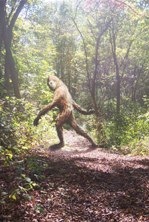 • A few tips for the novice Bigfoot hunter.
• Could the Son of Sam, a UFO investigating Air Force base and the birth of popular science fiction have helped create the Dover Demon?
• Michael Jackson may be dead, but his ghost is on a world tour.
• What happens, when myriad ghosts, have chosen to haunt a house, stop beings polite and start getting real? They say some really kooky stuff, that’s what.
• Rhode Island has never had a Bigfoot sighting, but that might be about to change.
Enjoy the weekend, as always, send weird photos, stories, sounds and happenings to JustinRobertYoung@Gmail.
Posted in Animals, Bigfoot, CHUD, Conspiracy, Crypto creatures, cryptozoology, Culture, Ghost Hunting, ghosts, Horror films, Rumor, UFO | Comments Off on Weird Week: Dover Demon, David Berkowitz, Chatty Ghosts, Lonely Bigfoot Hunters
Thursday, July 9th, 2009
In this column, we look at two pop-cultural interpretations of ubiquitous Weird legends as portrayed by two narrative television programs… like how Sam Malone on Cheers and Al Swearengen on Deadwood both manipulated the politics of an entire town from behind the counter of a bar. But with monsters. Enjoy.
This week:
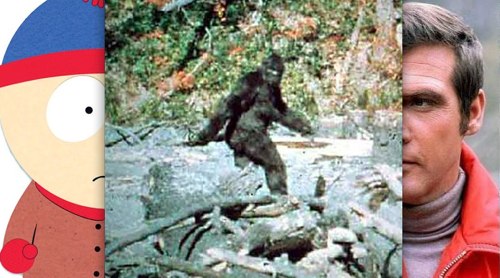
“Bigfoot is blurry.”
South Park, Episode 1×03, “Volcano”
The Six Million Dollar Man, Episodes 3×16 and 3×17, “The Secret of Bigfoot”
Bigfoot has always occupied a unique place in the pantheon of American cryptids. And I use “American” very deliberately here to suggest that, while sasquatches and yetis and abominable snowmen are found (and feared) the world over, Bigfoot is a specifically American cultural institution. Even the name “Bigfoot,” a simple, almost cute, descriptive moniker, suggests what ultimately seems to be the larger mystery that Americans wrestle with when they ponder the elusive, hirsute giant. It isn’t “Is he fact or fiction?,” but rather “Is he friend or foe?”
Both South Park and The Six Million Dollar man mused upon this question. One employed the query in revealing larger truths about pop culture’s grip on folklore. The other simply provided an answer… a weird, ridiculous answer.
(more…)
Posted in Bigfoot, Crypto creatures, Monster Sighting, TV Versus Weird Things | Comments Off on South Park & Six Million Dollar Man Reveal Bigfoot As Lovable American Icon