It’s traveled from one side of Canada to the other. It’s also traveled extensively all over Europe.
Now it’s about to travel from Salem, Massachusetts to San Fransisco, California…
Depending completely on the the kindness of strangers because it can’t move without them…
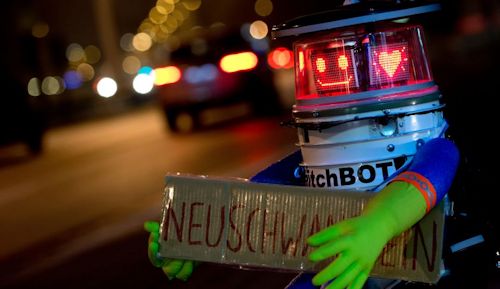
Because it’s an extremely low-tech, immobile, hitchhiking robot called HitchBot.
As the creators of this adorable little “robot” put it:
“We want to see what people do with this kind of technology when we leave it up to them. It’s an art project in the wild — it invites people to participate. It has a really low-tech look to it, something we dubbed the ‘yard-sale aesthetic”. The head is actually an acrylic cake-saver. We want to create something that has a bit of narrative to it, a sense of adventure. We don’t really know what’s going to happen.”
Hitch started its journey across the US on July 17th. Equipped with a disarmingly charming LED smiley face, a GPS and a camera that posts photos every 20 minutes to its Twitter account, Hitch is embarking on a completely unpredictable journey that many of us only dream of or think about doing “one day”…
And its just a little yard-sale-built robot reaching out to the world and hoping it’ll reach back.
Maybe “robots” have something to teach us after all.
Shoot us a photo and your story if you decide to help HitchBot get across the US at any point!
Since the very idea of giant robots the thought of giant robots beating the paneling off of one another has also existed.
Japanese movies, Rock’em Sock’em Robots, Voltron, Robot Jox, Shogun Warriors, Pacific Rim, Real Steel and a massive list of things with fighting robots have whet our appetites for something we all secretly want to be a real thing…
Wish no more!
It’s happening.
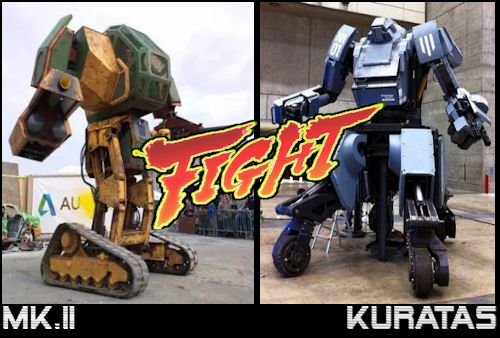
Recently the creators of the MK. II came out of nowhere with a video taunt aimed at Japan’s million dollar Kuratas. The creators of Kuratas responded with a snarkingly condescending video asking MK. II to put down its ridiculous cannon-ball launching and missile-firing weaponary and fight like a big metal man.
The guantlet has been thrown.
Now all we’re waiting for is a time and place.
A time and place where two giant metal warriors are going to bring our secret dreams into reality…
Hanson Robotics (no the “MmmBop” band hasn’t regrouped and out to destroy us with robots blaring their only memorable song as retribution) has been hard at work creating our future robot overlords in the form of…um…us.
Recently on display at the AsiaWorld Expo in Hong Kong, Han’s fiberglass bust is covered in a new, extremely life-like rubber compound called Frubber which if fitting since Han was created by an ex Disney Imagineer who’s now looking to take things to a whole new level of interactivity and realism.
Han is able to interact on a limited level with humans and can understand and carry on very basic conversations with those near him. Besides Han’s incredibly realistic expressions based on the conversation that he’s having, sensors in his eyes actually help him look directly into the soft, squishy soul of any human he’s actually speaking with.
In either case (as well as all the other similar robots Hanson Robotics has produced) let’s just be glad that Hanson Robotics is focused solely on robot heads….
Heads that, fortunately for us, don’t have legs…
Unless, of course, they get introduced to Boston Dynamics…
Because the thought of a Boston Dynamics Cheetah with a Hanson Robotics Face mounted on it would be a sign we should just prepare ourselves for the end.
In 2013 Boston Dynamics introduced its ATLAS robot to the public. It was a little creepy because the thing walked around sort of like a child learning to walk around…
Like this…
The only thing making us all feel relatively safe from the narrowing uncanny valley of movement that the robot was able to mimic was that the thing was tethered to a thick umbilical cord of necessary cables that provided electricity and signals.
It also kept the thing safely chained in a lab.
That’s changing…
The cord is about to be cut in an upcoming robot competition to help ATLAS become a completely free-range robot.
Like this…
While we’re excited that ATLAS will be used as a rescue robot in environments too deadly for our soft, fleshy bags of bones to enter and rescue humans…we know it’s only a matter of time before things go awry…
Created as a joint effort between SoftBank and French robotics company Aldebaran, Pepper a preciously adorable robot, was unveiled recently in stores throughout Tokyo.
The humans behind Pepper are hoping that everyone will want him to join their family in the very near future.
Pepper laughs, tells jokes, dances and probably quietly mocks us behind his adorable little face as he and his ilk develop their future plans.
Like a toddler or a pupper looking for a handout, Pepper constantly keeps eye contact with any human that he comes in contact with, can hold discussions about the weather and…stuff…and can do so in about 17 languages.
Determining the emotional status of humans via facial recognition and tone of our voices is another feature of the almost child-like metal man. Using algorithms and collected data from facial recognition studies, Pepper will seek to interact with humans in a way that will begin building the bridge across the vast ‘uncanny valley’ that exists right now between natural human behavior and robotically programmed behavior.
Looking to introduce him as a companion for seniors and as the gateway drug to having family service robots his price tag comes in under an affordable $2,000.
Masayoshi Son, Softbank’s CEO, stated during the press conference surrounding the unveiling of Pepper, “Several thousand Peppers are going to learn at the store (where the unveiling took place). Everything they learned and gained, is going to be accumulated into the cloud-based service. So that can be accelerating the evolution of the collective wisdom.”
Thousands of Peppers…connected in a hive-like mind.
Not too frightening, right?
He’s not even really mobile.
Until son added, “Our vision is to create an affectionate robot that can understand people’s feelings. Then autonomously, it will take action.”
Great.
Like when a bunch of silver, bipedal robots with glowing red eyes in the future autonomously ‘took action’?
Meet Otonoroid (the more stately female android on the right) and Kodomoroid (the awkward android on the left).
Unveiled in Japan as part of a future museum exhibit asking, “What is human?”, these two androids are accessing news stories in real time and delivering them to the audience. Not only can Kodomoroid ‘read’ the incoming news reports, she can translate them from various languages and read them aloud in other languages.
Who needs live human newscasters who require bathroom breaks, hair and make-up and can only work for a measly few hours before they get tired and need rest? Networks who buy news-reading androids and have a labor budget to swing under…that’s who.
As awkward as this demonstration is, it’s an interesting sign as to how robots are slowly becoming more and more integrated into our public lives.
While it all seems innocent and even a ‘cute’ demonstration of some oddly moving animatronics, it’s when Kodomoroid says something that should illicit a little, “Aw, Hell no!” from many of us human folk that we’re reminded of the possibility of a frightening robot-run future:
“My dream, when I grow older, is to have my own TV program. If you hear about a newscaster job, please, let me know.”
As the mechanical components that make up robotic prosthetics shrink, they’re integrating more easily into the lives of those that need them.
Drummer Jason Barnes built his own crude drumming hand but, after meeting an engineer who felt he could create something much more, Barnes now sports a pretty incredible robo-drumming arm. Using a technique called electromyography, the device responds to electrical signals as Barnes flexes his bicep. A secondary attachment for another drumstick was added that actually listens to what Barnes is playing and responds by playing along with what it’s hearing!
Giving talented people like Jason Barnes the ability to continue doing what they love and what they’re talented at is a fantastic way to get physically challenged people back to what they do best…
n this case it’s also the heralding of a whole new future for band battles.
[New Scientist]
For whatever reason, humankind and the geniuses that propel the science of robotics have impossibly ignored every science fiction film and book that has foretold of the impending replacement of soft, squishy people by cold, metallic machines that become better than us in every way imaginable.
In the latest ‘great idea’ to rid us of ourselves, several universities in England and Phillips Electronics have partnered to expedite the entire process by creating a cloud-based central control for four robots in a mocked-up hospital room.
Instead of several robots working on individual tasks, those same robots can all work together to accomplish one task cooperatively using a single hive-mind system dubbed RoboEarth!
Sounding more like some kind Monster Truck event at the local fair, RoboEarth will allow various robotic systems to collaboratively solve problems.
What does that mean? It means that one robot will use heat signatures to let several hovering drones know where the last remnants of humanity are so that we the robot takeover will go in a very organized and methodical fashion than Hollywood’s silly notion that we’ll rally together and be victorious.
Rene van de Molengraft, the head human exterminator of the RoboEarth project, states, “At its core RoboEarth is a world wide web for robots: a giant network and database repository where robots can share information and learn from each other.”
Over a weekend at Fort Benning, human inventors of automated robotic war machines showed off the devices that Skynet will probably use against us when it goes live.
Musicians are usually willing to jam with anyone that has some ability at playing an instrument. As we begin walking hand-in-hand with our quickly-becoming-commonplace robotic friends, it only seems natural that musicians and robots would start creating the modern equivalent of their own Wyld Stallyns.
Other bands, like Compressorheads, have tread this road long before Z Machine. It just seems that right now we’re all a little more comfortable with our new metal friends and Z Machine has hit the stage at the right moment because of the reaction that the band’s had overseas.
Z Machine performs a lot like an emo band who’s feet have been nailed to the floor in the video we’ve posted here. That looming alien thing in the background on the left seems to be on a union break.
Despite the feeling that this performance is like we’re watching the result of something that’s been a weekend project between the glee and choir clubs, this is a simple, innocent example of how welcoming a new generation is of their new robotic buddies.
Quadcopters are the new must-have toys of the tech-headed kids. They’re showing up everywhere and there are thousands of them out ‘in the wild’.
For those frightened that these things will eventually be controlled by SkyNet, this latest advancement in their abilities is only going to reinforce that paranoia.
For the rest of us who believe our robot friends would never hurt us based on a set of laws thrust into existence by an author of science fiction novels? This is pretty awesome to watch.
For a more detailed description of how exactly this whole process works, you can check out RoboHub for a more educational explanation than anything you’re ever going to find here.
Those that just want to be amazed at a serious demonstration of how organized, responsive, agile….
Know what? Forget we ever called those people paranoid.
Across the globe from the uncanny valley that is Diego-san’s facial expressions, the University of Zurich’s Artificial Intelligence Laboratory making another weird foray into the creation of a robot toddler.
Roboy is being developing with the help of crowd-funding,, sponsorships and almost 40 engineers and scientists.
Just like its weaker, fleshy, real-life inspiration, Roboy’s design gestation is going to take about 9 months to full completion.
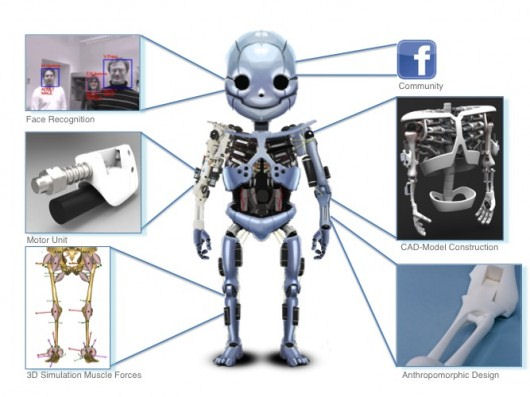
Roboy is being developed to ease people into actually living with robots and not being creeped out by them. Roboy’s face was chosen during a Facebook contest. Its body is made entirely of plastic and will be covered with a fleshy, rubber-like material to simulate skin. Unlike typical robot movement mechanisms, Roboy will feature elastic cables pulled by motors in order to provide movement more human-like and less bad robot-dance-like.
Part of Roboy’s mission is to help build a bridge across the uncanny valley and get people more comfortable with having robots around and being a part of their lives.
Service robots are going to be a part of our lives in the very near future. As the population ages, new generations will already be more comfortable with having robots around and using them to do menial tasks for us.
Roboy will heading out into the world as part of the ‘Robots on Tour’ event that begins March and will exhibit all sorts of our future replacements.
Then there’s that incessant and nagging subconscious feeling that we might piss them off and see an army more terrifying than anything Hollywood could put in front of our peepers….
Got an event coming up real soon? Maybe a wedding? Maybe a birthday?
Well in case you are and you’re wondering where to find memorable entertainment for your party? Look no further than Ebay.
Right now, because of a ‘changed business model’, you can now have an entirely Hillbilly band play at your event!
A petting zoo/amusement park in Massachusetts has decided to bid farewell to this frightening group of robotic performers designed and built by an ex-Disney Imagineer (we kinda get why he’s an ex-Imagineer).
Originally this band cost the company $15,000. They’re letting go of the whole group, including the porch if you dismantle it yourself, for a steal at $5,000! Total deal.
You only have a couple of days left to snag the entire group so you’ll have that special ‘something’ that leaves an impression on your event’s guests that they’ll never forget..
Like when they all suddenly stop playing, turn their heads to look at you with their unblinking stares and then quickly return to playing one of their beloved jigs.
Many of you might remember Teddy Ruxpin as something of a tech marvel of the 80s. Teddy Ruxpin was like having your own Disney animatronic as a kid. Insert a cassette tape into his back, press play and Teddy Ruxpin would lip-sync to recordings of stories featuring his adventures…or to any of your favorite bands…or to Eddie Murphy’s Raw standup act. Any audio you could pipe into him, he’d lip-sync to.
Teddy Ruxpin is back…in probably the oddest, almost creepiest way possible…an art installation that reads posts from Twitter out loud.
Eighty Teddy Ruxpin’s have been wired and attached to a wall by Sean Hathaway as part of an installation called TED ( “Transformations, Emotional Deconstruction” ).
Here’s Hathaway’s explanation taken from his official site:
TED is a large, wall-based installation consisting of an array of 80 Teddy Ruxpin dolls that speak emotional content gathered from the web via synthetic speech with animated mouths. The speaking of the emotional content is accompanied by one of twenty-four musical vignettes that have been paired to the emotional content being spoken. Each vignette, representing one of twenty-four subtle variants of human emotion, have been composed in such a way that the beginnings and ends of the short pieces will seamlessly dogleg in any possible configuration and stream endlessly as a unified whole. The installation is allowed to drift about freely through the emotional landscape being driven only by those who are contributing content to the piece whether unwittingly or consciously. As such the overall presentation of the piece can vary greatly based on external conditions such as seasons, world events and even time of day.
Hathaway also states that, “The piece is essentially taking the instantaneous emotional pulse of the internet and this collective pulse, like a human pulse, varies over time,”
Below is a video of the installation at work.
Just don’t watch it before you lay your little precious head down for the night…it’ll probably change your pulse as well…but not in a good way.
Robots. They’re already everywhere just waiting for SkyNet to give the word.
Up until now they’ve all been land-based future threats to humanity…up until now.
Besides Bruce, the shark from the original Jaws movie, robots that take to water are about as rare as cats who enjoy a good shower. Specifically humanoid ones.
Swumanoid is about to change that.
Swumanoid, created by Chung Changhyun and Motomu Nakashima at the Tokyo Institute of Technology in order to measure water resistance.
Created using a 3D printer and featuring about 20 waterproof motors, Swumanoid is able to accurately perform a breaststroke, backstroke, butterfly, dog paddling and even tread water.
So if you’ve finally gotten over the whole “I’m scared of deep water because I don’t know what’s in there and it freaks me out” craze?
You now have something else to fear in the water besides a mechanical great white shark…