Created by artist Martin Backes, this installation of a lone “robot” singing 90s power ballads is almost hypnotizing in a quietly terrifying way.
Fittingly created with SuperCollider, a freeware audio program that synthesizes audio using algorithms, “What do machines sing of?” is an art project where the machine attempts to mimic human sentiment in an extremely haunting way:
“What do machines sing of?“ is a fully automated machine, which endlessly sings number-one ballads from the 1990s. As the computer program performs these emotionally loaded songs, it attempts to apply the appropriate human sentiments. This behavior of the device seems to reflect a desire, on the part of the machine, to become sophisticated enough to have its very own personality.”
Let’s hope the behavior of this device doesn’t reflect a desire, on the part of the machine, to become sophisticated enough begin giving motivational speeches to robots within earshot on how to overthrow the human race.
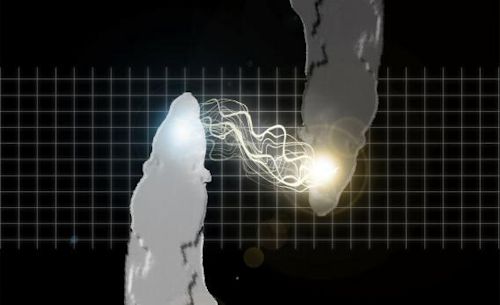
At Duke University a researcher who’s pioneering brain-computer interfaces has circuited four rats’ together via their brains and created a gooey and organic “Brainet”.
Miguel Nicolelis, the neurobiologist pioneering this neuroengineering at Duke University has spent 30 years doing similar experiments in hopes of uncovering the secrets of the human mind.
Earlier, in 2011, Nicolelis connected the brain of individual monkeys in order to get them to work a virtual monkey arm and grab virtual objects with it using only their mind. It didn’t take long for the each monkey to grasp the process mentally and move their extra invisible monkey hand.
Nicolelis then wondered if it were possible to string together several brains and have the work together to perform particular tasks. He used four rats to test the idea.
In order to get a drink of water the rats would have to learn to work together mentally to get a drink. In a short amount of time the rats were drinking regularly as normal.
Currently the rats have Frankenstein-like electrodes embedded in their heads. That will change as the technology progresses until it’s completely non-invasive.
What can we gain from a “brainet” as humans? Will we eventually become Borg-like? Is it smart to move toward a hive-mind? Who knows.
Downside? Enough people are connected via their brains and someone hacks the “brainet” to make the world bow before them. Upside? Natural disaster takes place and we use the “brainet” to locate those in need of help and almost telepathically send the information needed to medically aid those people even though the person at the receiving end might not be trained in life-saving techniques.
The entire idea is still in its infancy as to the possible applications but as Nicolelis points out:
“These computers will not do word processing or numerical calculation or internet searches, they will be tailored for very specific tasks like what animals are tailored for. It’s a totally different kind of vision for computation that we’re not used to.”
The whole process is intriguingly involved and fascinating….and somewhat terrifying.
Imagine waking up and being hooked to someone else’s brain?
Or imagine that this is slowly becoming a reality….
A long time ago on the WeirdThings podcast, because we’re always ahead of the curve when it comes to hypotheticals about how new tech might be used in ridiculous scenarios, we pondered how someone might use smart-car tech to commit manslaughter by hacking a vehicle and driving it into a squishy human being.
Jaguar is pushing that possibility into becoming a very real scenario.
Currently the vehicle has severe limitations on speed (it tops out at 4mph) and the distance that the phone is from the vehicle (the car stops when the phone is too far or too close).
It’s still early in development and still early to really understand how an average user might need this kind of control over their car with autonomous vehicles rolling into the public traffic and becoming part of our every day lives.
Sure….it all sounds safe…
But like the curious primates we are…
It’s only a matter of time before curiosity…and an unmanned Range Rover with a driver on smartphone miles away…kills the cat that’s crossing the road.
Since the very idea of giant robots the thought of giant robots beating the paneling off of one another has also existed.
Japanese movies, Rock’em Sock’em Robots, Voltron, Robot Jox, Shogun Warriors, Pacific Rim, Real Steel and a massive list of things with fighting robots have whet our appetites for something we all secretly want to be a real thing…
Wish no more!
It’s happening.
Recently the creators of the MK. II came out of nowhere with a video taunt aimed at Japan’s million dollar Kuratas. The creators of Kuratas responded with a snarkingly condescending video asking MK. II to put down its ridiculous cannon-ball launching and missile-firing weaponary and fight like a big metal man.
The guantlet has been thrown.
Now all we’re waiting for is a time and place.
A time and place where two giant metal warriors are going to bring our secret dreams into reality…
In 2013 Boston Dynamics introduced its ATLAS robot to the public. It was a little creepy because the thing walked around sort of like a child learning to walk around…
Like this…
The only thing making us all feel relatively safe from the narrowing uncanny valley of movement that the robot was able to mimic was that the thing was tethered to a thick umbilical cord of necessary cables that provided electricity and signals.
It also kept the thing safely chained in a lab.
That’s changing…
The cord is about to be cut in an upcoming robot competition to help ATLAS become a completely free-range robot.
Like this…
While we’re excited that ATLAS will be used as a rescue robot in environments too deadly for our soft, fleshy bags of bones to enter and rescue humans…we know it’s only a matter of time before things go awry…
Robots. We just can’t stop building them even though countless movies tell us where it’s all headed. Not only can we not stop trying to emulate ourselves mechanically, a small portion of the robotics community can’t stop trying to emulate creatures from the animal world.
One of the latest creations by a group called FORTH (Foundation for Research and Technology-Hellas) is a tiny little robot trying to emulate the natural actions of octopi and squid.
The video above showcases the features and development of the robot as it goes from having bare legs to more efficient webbed legs to carrying an object in a couple of its legs (check out the little yellow ball it’s carrying) to going for a swim out among more natural life in the actual ocean.
It’s fascinating and almost relaxing to watch as it pulses through the water.
Relaxing until someone attaches tiny laser-guided torpedoes to it.
Like an elaborate version of the famous Pepper’s Ghost effect where a projection appears to interact with a real world person, this incredible floating haptic interface will absolutely blow your mind…
Because unlike Pepper’s Ghost? You’re actually able to physically feel and interact with said projection!
During the video several scientists working on the project show how it works by giving quick demonstrations to illustrate what’s actually happening. What’s actually happening is nothing short of witchcraft or sorcery or the future kissing your eyeballs and saying, “I’m finally here, guys! Jetpacks and hoverboards due out next week!”
Sure it’s overkill instead of just touching an actual monitor but think about doctors ‘feeling’ their way through a replicated cadaver to learn about the body or perform practice surgeries without it being detrimental to an actual living being?
But what we’re all really thinking is, “When do we get a Danger Room or a Holo-freaking-deck already!?”
As Google continues to document every crevice of our world with a camera so armchair world travelers can sit at home in their underwear and globe-trot, they’re realizing that a car with a first-gen Imperial Probe Droid mounted on its roof can’t go quite anywhere.
Google decided to ‘street view’ the Arabian desert of Liwa.
Since cars can’t tread sand, they strapped their all-seeing-eye to the back of a camel and let some poor schmuck wander the desert so we could all virtually enjoy the experience of being stranded in a desert without all those little inconveniences like thirst, dehydration, delirium and…you know dying alone in the desert.
Meet Otonoroid (the more stately female android on the right) and Kodomoroid (the awkward android on the left).
Unveiled in Japan as part of a future museum exhibit asking, “What is human?”, these two androids are accessing news stories in real time and delivering them to the audience. Not only can Kodomoroid ‘read’ the incoming news reports, she can translate them from various languages and read them aloud in other languages.
Who needs live human newscasters who require bathroom breaks, hair and make-up and can only work for a measly few hours before they get tired and need rest? Networks who buy news-reading androids and have a labor budget to swing under…that’s who.
As awkward as this demonstration is, it’s an interesting sign as to how robots are slowly becoming more and more integrated into our public lives.
While it all seems innocent and even a ‘cute’ demonstration of some oddly moving animatronics, it’s when Kodomoroid says something that should illicit a little, “Aw, Hell no!” from many of us human folk that we’re reminded of the possibility of a frightening robot-run future:
“My dream, when I grow older, is to have my own TV program. If you hear about a newscaster job, please, let me know.”
Disney is continually developing things that will make us hand over a substantial amount of cash to play in their parks.
Recently the Disney Research Hub’s YouTube Channel dropped a video showing something called PixelBots.
As entertainment in the real world becomes more interactive due to the public’s insatiable appetite for new experiences, companies like Disney continue to push into new areas of the interactive experience.
What will Disney be using these lemming-like little ‘bots for? Hard to say.
We’ll let you all role-play the part of an Imagineer in the comments.
In what’s probably the cheesiest way to show this incredible feat off, HeliGraphix, a company that specializes in aerial photography using RC helicopters, has posted a video of something that we’ve all probably kinda thought, “…if only…”.
Using two appropriately named copters called H.U.L.C.s (Heavy Ultra-Lifter Cranes), Heligraphix took one brightly dressed woman who dances like your mom trying to be sexy in front of your friends and lifted her off the ground like she weighed nothing! Seriously. These are RC helicopters and you wouldn’t think this would even be feasible.
But a lot of things…a lot of things that once lived only in our adolescent, pretend-I’m-a-spy imaginations…just became very, very feasible but it looks effortless!
Google has a new program where they’re asking hikers who’re willing to strap a on 40lb Google Street View backpack version of the device that’s usually strapped to the roof of a car. They’re asking that, should you be heading off to explore some interesting part of the world, if you wouldn’t mind ‘street-mapping’ it for the rest of us to lazy to get up and do it for ourselves.
Recently a team of willing urban explorers went to Hashima Island (also known as ‘Battleship Island’) with the blessings of the Nagasaki government. While tourists have been visiting the island since 2009 their exploration area is very limited because of dangerous conditions. Google’s team, fortunately for the rest of us, was allowed to explore much more of the island so that all of us can now visit this hauntingly unique place.
Age-Related Macular Degeneration (AMD) is one of the many joys associated with getting older. New generations of AMD sufferers won’t have to worry about that in the rapidly approaching future.
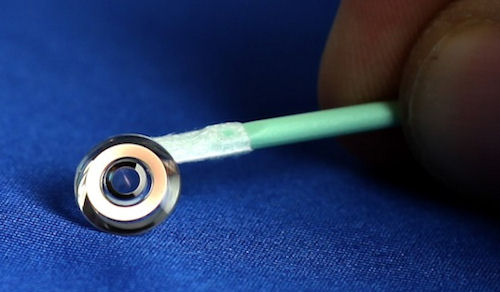
DARPA has funded the development of contact lens that operates like a millimeter-thick telescope. Using something along the lines of magic, the wearer of the contact will be able to switch between normal vision and magnified vision with the help of liquid crystals and ridiculously small, precisely engineered mirrors.
Basically you’ll be wearing the mechanical focusing rings of a standard still-photo camera that’s been flattened incredibly thin while retaining its functionality.
It’ll still be a while before these things trickle down to the average consumer but if you were to ask some of the future consumers if it was worth the wait? Pretty sure the answer would be a “Yes”.
Musicians are usually willing to jam with anyone that has some ability at playing an instrument. As we begin walking hand-in-hand with our quickly-becoming-commonplace robotic friends, it only seems natural that musicians and robots would start creating the modern equivalent of their own Wyld Stallyns.
Other bands, like Compressorheads, have tread this road long before Z Machine. It just seems that right now we’re all a little more comfortable with our new metal friends and Z Machine has hit the stage at the right moment because of the reaction that the band’s had overseas.
Z Machine performs a lot like an emo band who’s feet have been nailed to the floor in the video we’ve posted here. That looming alien thing in the background on the left seems to be on a union break.
Despite the feeling that this performance is like we’re watching the result of something that’s been a weekend project between the glee and choir clubs, this is a simple, innocent example of how welcoming a new generation is of their new robotic buddies.
There’s really not much to talk about here with a bunch of words. They’ll just get in the way of you pressing play and smiling like a little kid as your brain sort of automatically speculates on the possibilities of this in peoples’ homes.
We’ve all dreamed of the Holodeck being a part of our secret lair at home. Microsoft’s new IllumiRoom is a lot like watching a baby take its first steps in the direction of Holodecks becoming a standard part of any man-cave.
Sure we’ve seen mapped projections before like at Walt Disney World’s Magic, Memories and You show at the Magic Kingdom…but nothing on a consumer level and nothing with this kind of customization. Using a Kinect, a couple of cameras and some software, this is something that, while in its newborn stage, could lead to some truly innovative projects and ideas…or just mean that we’re going to be leaving our mother’s basements way less than we already do.
Recently a group of Japanese scientists at the IEEE Virtual Reality Conference in Orlando, Florida have unveiled
the latest incarnation of…
(sad, loungy drumroll please)
Smell-O-Vision!
That’s right. Scientists have been working hard at making your television smell.
Do we really need to smell the elephants of Africa while watching a beautiful documentary about the animals?
No. Not really.
But advertisers sure would like us to get a whiff of things like the latest addition to the IHOP menu, the latest
colognes and Pilsbury would take the obesity problems in America to a whole new level when that little chubby, animated
chef shows up shoving a tray full of warm, delicious chocolate chip cookies in our faces.
Using gel pellets placed at the four corners of the monitor and small air-streams, scientists are able to get fairly
specific across the face of the monitor where the smell will seem to emanate from. Think of it like 5.1 surround sound but
your nose is the one in the recliner experiencing it.
Modern day theme parks like Universal and Disney often use gel packs or cartridges to send the smell of candy, food or, in the case of Universal’s
Halloween Horror Nights, the smell of rotting meat to add a subtle something to guests’ in-park experience.
What was unveiled at the conference is still fairly primitive but technological developments will continue to improve and
pretty soon you could be smelling the oil and smoking metal of Call of Duty…
Or the sweet, acrid smell of a Well Zombie from the Walking Dead.