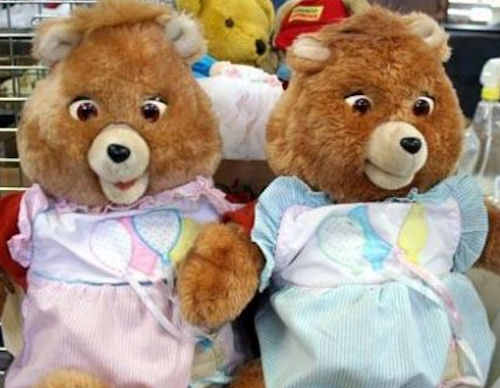
Talking Animals, They’re Just Like Us! They Murder! Predict The Future! Chat On Christmas!
Wednesday, February 17th, 2010If there’s an educational takeaway from the story of David Berkowitz – New York’s notorious trigger happy killer who claimed to receive murderous orders from his neighbor’s Labrador retriever – it’s “don’t listen to talking animals.” Or maybe “only listen to talking animals if the animals are horses and they’re explaining that, for them, horse races are basically set up like the WWE, with good horse characters and evil horse characters, and if you help them write the scripts, you’ll know in advance who’s going to win each race.” I wasn’t always so cynical regarding this topic. As a child, I was fascinated when my parents told me about the European superstition that Christmas Eve (technically, 12 am Christmas morning) finds animals imbued with the ability to speak. In fact, if our cat had sidled up to me and said “Yo, Matty, kill me some folks, would ya? I love you!” I can’t guarantee that I wouldn’t have at least gone downstairs and selected a knife. Probably even the biggest knife. But not anymore.
Like many early European Christmas traditions, it’s difficult to trace the talking animal thing back to any definitive Christian origin (because it’s pagan as f***). According to Christian bloggers, the temporary gift of gab is god’s annual thanks to all animals because several animals were present for Jesus’ birth. I’m gonna be honest, god – kinda feels like you’re reachin’ there. What’s really crazy, though,
is that, despite the legend’s seemingly holy origins, Europeans also believed that it was never good to listen to the speaking animals (probably because it’s pagan as f***). My favorite story re: talking animals – don’t listen to them! comes from the German Alps:
A farmer was so curious to hear what his two horses might say (probably he was hoping for the WWE thing) that he decided, against all rational thought, to listen in on their holiday jabberjawing. So, come Christmas Eve, he hid in the rafters of his barn and eagerly awaited the stroke of midnight, upon which one horse suddenly turned to the other. “We shall have hard work to do this week,” said the horse. “Yes. The farmer’s servant is heavy,” answered the other. “And the way to the churchyard is long and steep,” replied the first. The farmer was baffled by the conversation until, later that week, his servant died suddenly. The horses were then needed to carry the man to his grave.
There are other, more predictable tales in which mistreated animals use their speech to fatally trick abusive owners; there are even kids’ stories where house pets are all grins and giggles and psyched about Jesus. But that horse story… utterly chilling. The old Christian view was that it was god’s intention for the animals to share the gift amongst one another, but not with people – animals have strange and secret knowledge (bordering on pagan as f*** occult power) not intended for human ears. As in the horse story, to eavesdrop on their whisperings is to receive startling insight into the dark heart of a natural mysticism from which humans, in civilizing, became unknowingly disconnected.
All inevitable questions (Is the significance of the gift simply to offer lower beings the power of human [read: higher] language? If so, do non-domesticated animals – animals that don’t willingly cede to man’s dominion – really even give a care?) aside, the superstition is another interesting example of how, in the same way that the architecture of Rome was defined by the heathen network of pagan shrines that compose its foundations, Christian beliefs are pasted to a skeleton of solstice orgies and magic animals.
When the muted scratching behind the farmhouse’s old wooden walls turned into strange hissing and humanoid gurgling, the Irving family began doubting their early theories of wild mice and scavenging rats. So it seemed reasonable and, like, totally OK when, in 1931, a swaggering, bushy-tailed mammal sashayed out of the darkness and introduced himself, in perfect English, as Gef, “an extra, extra clever mongoose.” Over the years, Gef entertained thirteen-year-old Voirrey (the only Irving who could actually see the creature), and her parents, James and Margaret, with tales of his exotic Indian upbringing, fantastical claims of supernatural powers and even scandalous neighborhood gossip, which he claimed to obtain through extensive eavesdropping and daring spy missions. Occasionally, Gef would get rowdy and toss objects around the Irving house, or perpetrate Kutcherian japes, like the time he convinced the family that he had been poisoned, but overall, the mongoose’s seven-year stay, as documented in a journal kept by James Irving, was a pleasant one.