Over the last couple of weeks, Mother Nature has decided to remind all of us who’s really in charge.
Here’s the rundown of recently terrifying yet gentle reminders from her:
Deadly Spiders vs Homeowners:
After purchasing a house from the previous owners who failed to disclose that it was actually a destination spot for the deadly brown recluse spider, the latest owners began discovering spiders everywhere until they were eventually bursting out of the walls.
A conservative estimate of 6,000 spiders were said to be lurking in the house.
In Arizona several landscapers got too close to a 100 pound hive of Africanized Bees that had taken up residence in the comfy attic of a home the landscapers were working around.
On one side people proclaim it’s a great place to vacation. On the other side are the people who live there who are completely aware of the fact that it’s just wet sand covering a giant Hellmouth.
Seriously…the sky tries to kill people with bolts of lightning, the ground tries to swallow anything that lives on it whole and the things that crawl around aren’t like things that crawl around anywhere else.
Case in point…
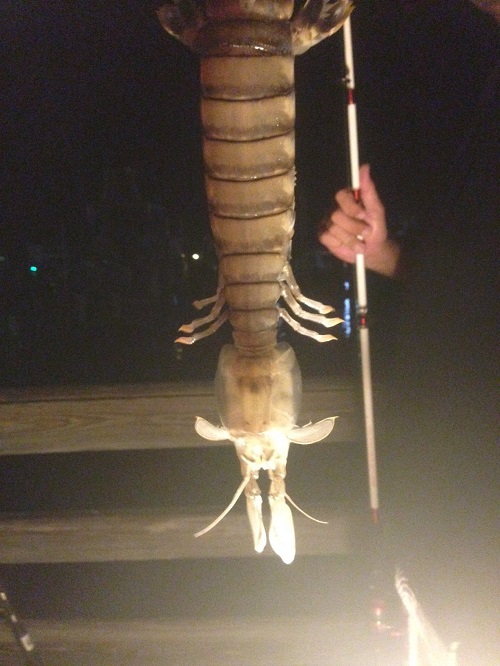
A fisherman off the coast caught the Face-Grabber’s cousin the other day.
It’s called a Mantis Shrimp…and the one that was caught (at night we’d like to add) is bigger than most (and probably a sign that something’s also happening in Florida’s water because…well…it’s Florida).
Imagine if you rolled a predator, one of Ridley Scott’s aliens, a mole person, a little bit of a Grim Reaper and a highly skilled ninja into a living animal and slathered it in ugly.
Ta-Da! Mantis Shrimp.
Florida’s Fish and Wildlife Commission posted a picture of a super-sized one of these nightmares on their Facebook page and it’s gone viral with good reason…it’s terrifying and it lives in the sand…under your feet.
Next time you think about exploring Florida because you’re bored of the theme parks?
Just…here watch this and imagine one of these about 7 times the size of the one in the video…and crawling up your leg.
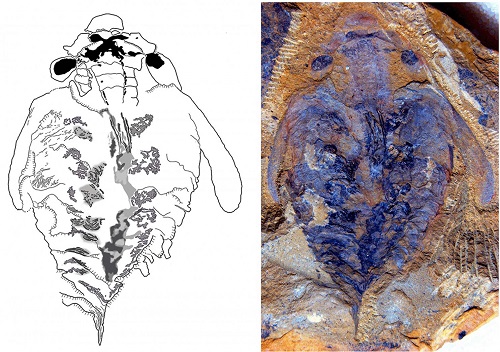
That’s the name for a bucket of strange insect-like creatures with terrifying pincers that crawled around on the ground billions of years ago and ate other, not-as-scary insect-like creatures with only semi-terrifying pincers that crawled around on the ground billions of years ago.
Chinese scientists have recently discovered the fossilized brain tissue of a group of animals called Lyrarapax unguispinus, a fun group of nasty creatures that have no modern day relatives save for a much smaller worm that isn’t quite as terrifying found in the tropics.
Dear scientists…just keep working on the cute, furry woolly mammoth. These don’t need to come back.
Any time you mention the word ‘reindeer’ most people conjure up a fond memories of Rankin/Bass Christmas specials from their childhood, sing “Rudolph the Red-Nosed Reindeer or just freak out because you just reminded them they’re only three shopping days left until Christmas.
Unless, of course, you live in Finland….
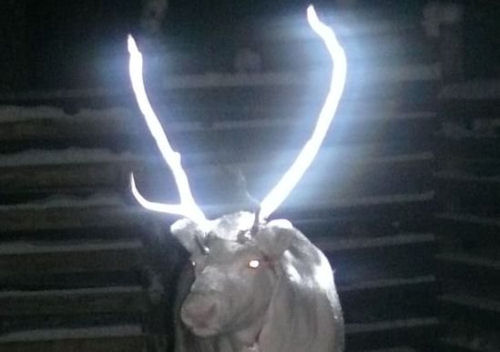
Where you’ll probably have nightmares about eerily glowing reindeers who wander the forests at night.
Every year in Finland, almost 4,000 potential sleigh-pulling reindeer are struck by motorists. In order to protect these animals and save Christmas, the Finnish Reindeer Herders Association (yep…it’s a thing) has come up with an idea that will probably result in more motorist crashes when drivers try to avoid killing what looks like a ghost-demon reindeer.
By painting the reindeer’s antlers with reflective paint, the Finnish Reindeer Herders Association is hoping to keep the mayhem to a minimum next year. They’re currently just splashing the reflective tape on the animals’ fur to test the theory while Canada, who’s suffering similar issues, simply wants to paint some reflective lines on the road and maybe put up a sign saying, “SLOW DOWN OR YOU’LL PROBABLY KILL A REINDEER!”
We’re looking forward to posting stories about people who do NOT know this is going on in the wilds of Finland and post stories to the internet about “Satan’s Reindeer”, “Reindeer Ghosts of Christmas” or the conspiracy stories that Nikola Tesla once developed a freaky form of reindeer that channels electricity through its eye-holes and antlers.
No…really…look at that picture up there…eight of those, and one with who-knows-what coming out of its nose, will be on your roof in a couple of months.
There’s going to come a point when we’ve just run about used every animal to give human beings massages and facials. That day’s not here yet but by the time we get news that an irate army of fire ants is being used to relax people in a spa in some tiny, remote country we’re probably just going to shrug out an, “Eh.”
Currently a spa in Indonesia is using many peoples’ nightmarish cuddle-buddy to relax them. “Relax” would be the wrong word to use in this case. The theory is that adrenaline, which is triggered by the fear of having a giant python crawling across your naked body, and the snake’s movement, are supposed to be good for your skin.
Fearing for your life sounds exactly like the opposite of the whole idea behind visiting a spa.
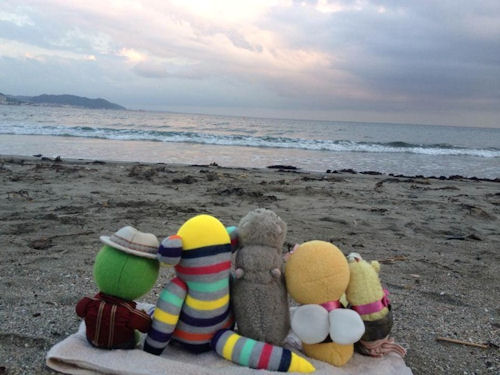
Everyone dreams about traversing the globe and visiting all of those places that are on most of our bucket lists. Unagi Travel is a company that will help your plush animals reach that goal while you live vicariously through video and photos of their journey.
For a small fee ($20-$35) your small plush pal can go globetrotting while most of us sit at home shoveling Doritos and staring at the internet for hours.
For just over three years now, Sonoe Azuma has been taking peoples’ stuffed friends on trips all over the world. Sure it seems weird when you first read about it…and then comes the almost gut-hitting reason that some people send them…because they simply, physically can’t do so. Like a 51-year-old woman for whom walking had become difficult due to illness:
“I want to see and walk around the sights that I viewed through my stuffed animal’s journeys someday. Seeing my stuffed animal traveling encouraged me. I began to think that I should do what I can do, instead of lamenting over things that I can’t.”
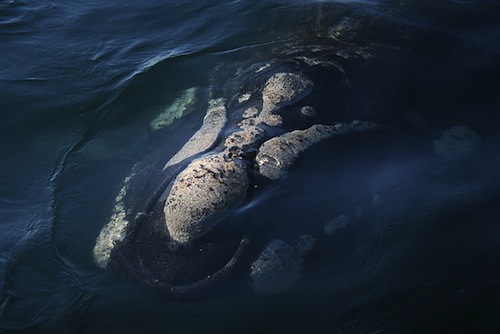
Seagulls are about the very last animal you’d think of when someone ask you to name something that might kill a full-size whale.
But that would just mean that weren’t keeping up on the events taking place out in the waters off the coast of Argentina.
Because trash isn’t covered or really being recycled on nearby land, the gull population has exploded in recent years. No one’s really sure when it started but with dead whales turning up on shore, researchers began noticing something a little unsettling…peck marks.
Seagulls are opportunists like vultures when it comes to an easy meal. At some point a gull realized that whales are pretty easy targets when they come up for air. Now that behavior has become the norm for thousands of these birds. During the calving season when babies whales are born the problem is exacerbated because baby whales need to stay up longer to feed off their mothers. Routines are changing because of the gulls and their relentless attacks…the calves feeding time is shortened. Calves bodies are washing up on shore suffering obvious effects of malnutrition.
Local government is allowing a cull of the birds within the month and targeting the birds who’ve developed this behavior. It’s been done before with no real change in the birds’ behavior.
Let’s all hope this gets sorted out…because once, and we’re just tossing this out there because we like to get hypothetical this way, we run out of whales…
Buttercup is an adorable little duck who was born with one of his feet turned backwards.
Born at a high school as part of a biology program, Buttercup was given to a sanctuary specializing in dealing with ducks.
Software engineer for the sanctuary, Mike Garey, took Buttercup under his wing and began looking for ways to give this little duck a much-less painful method of mobility.
Using photos of Buttercup’s sister Minnie’s foot, NovaCopy, a 3D printing company that Garey had gone to, created and then printed a copy of the foot.
Just last night, Buttercup was given the new foot to test out and the result is something that’ll make even hard-nosed haters of cute stuff smirk a little bit at.
The video above is Buttercup before the new foot. The video below is Buttercup with the new foot.
Watch as this door opens up and something spills straight out of this closet and into your nightmares.
This is Julius and yes…this thing DID learn to open even round doorknobs. So you’re really not safe anywhere.
Julius passed away in 2012 from an infection that her vet could not diagnose. While we’re saddened about that…we’re glad that Julius didn’t get the chance to visit Florida and teach the rampant pythons here this trick.
That would’ve finally dumped the Sunshine State into the hellmouth it currently sits on.
Pigeon racing is quickly becoming a hot place for a new generation of wealthy people in China to drop some cash. In fact it’s attracting drops of cash worth millions. One race can net the winning team’s owner upwards of $80,000. There’s even a black market for racing pigeons being fed by pigeon pirates. Who knew?
We were just informed that Mike Tyson apparently knew this’d be hot before all of us.
It wasn’t too long ago that North America’s Hellmouth of a state was calling for people to go out into the wild and bag/kill as many giant pythons as they possibly could.
Now that that’s yesterday’s Nature versus Humankind battle is over, everyone’s favorite birthing place of weird EVERYTHING is taking us back to the good old days of that era of 1970s horror films when piranha, worms, snakes, rats, bears and even tadpoles decided they were tired of sharing the planet with us.
Just what the hell is this new scourge that’s coming to wreak havoc upon us now?
Brace yourselves, people…
Snails.
SNAILS!
And they’re exactly the kind of snails some of you are imagining right now…
Giant African Snails that can grow to 8 inches long, devour 500 different species of plants and (you’re going to slap your face like Maculay Culkin in Home Alone right about now) they are tearing through stucco and peoples’ homes! Not only that but the snails’ shells are big enough to puncture car tires because they’re Frogger-like skills are nonexistent!
Sometimes towns and even countries have to stretch to lure potential tourist dollars.
Occasionally the only thing are some strange promises of something unique about a particular area.
We’ve all seen photos of the Giant Ball of (insert something you might make a giant ball out of). You might be surprised just how many will actually drive out to seek these over-the-top and almost accidental attractions.
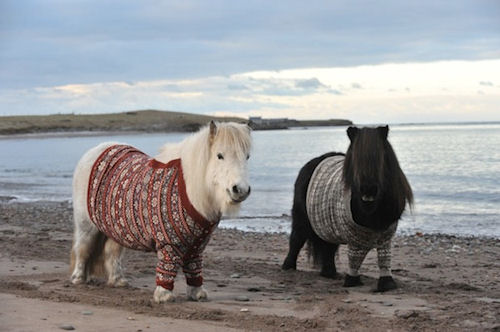
To celebrate the ‘Year of Natural Scotland 2013’, the ‘Visit Scotland’ website has created something that might possibly cause peoples’ heads to explode in a ball of confetti, sparkles and female anime character giggles.
They’ve taken one adorable thing and one questionable fashion choice of Scottish heritage and combined them into a nexus of weirdly cute by dressing two ponies, Vitamin and Fivla….
…in cardigans.
Most local websites that often state: ‘Come See the Town of _______ where you can sit for hours and see local squirrels bury their nuts or sit by the lake for hours on end while wondering about other towns where something exciting might be happening’ just never seem to help garner enough buzz for you to even consider visiting.
But…two adorable ponies made even more adorable because they’re wearing sweaters?
We’ve all heard the expression ‘something old is new again’. Well that, and the fact that Florida was apparently created on top of an ancient Hell Mouth of some sort, brings this creepy discovery coming out of Miami.
Residents of a fancy-shmancy resort on the waters of Biscayne Bay in South Beach had been smelling something ‘unique’ in their building.
It wasn’t the uniquely fancy-shmancy food.
Three chickens and one goat washed up together on the sidewalk behind the resort. They were all missing one important thing…their heads.
After phone calls were made to the police regarding the animals, a spokesman for the department said that they weren’t going to get involved because “the dead animals didn’t appear to be sacrificed as a threat directed against any particular individual.” So instead? They just let them rot there for a couple of days.
Eventually Richard Couto, an investigator of the Animal Recovery Mission, stated that the animals seem to have been killed as part of a Santeria or Palo Mayombe ritual. Everyone involved, with the exception of those living in the nearby luxury condos, simply shrugged the event off as something that happens all the time because of the mixture of Afro-Caribbean cultures in the area. Animal sacrifice for religious purposes is also not against the law and is protected under first amendment rights.
Where the animals actually came from is still a mystery. Other reports of animal sacrifices in the area have been quietly popping up in the local news but those too are being ignored as just something that happens in the area.
Is there something else going on in South Florida?
We’ll be watching…but we’ll be locking up our pets…you know…just in case.
Christmas has come and gone. Statuses everywhere are lit up with the swag given by friends and family.
Someone’s aunt got them this. Someone’s brother got them that.
Big flippin’ deal.
Why?
Because a group of scientists have been given gifts from freakin’ dolphins since 1998!
Dolphins!
Dolphins that offer gifts to humans!
Though the dolphins at the Tangalooma Island Resort in Australia haven’t been dropping PS3s or brand new iPhones they have been presenting gifts of food to human recipients. Scientists that have been studying these particular dolphins on a regular basis and in frequent contact with them have received everything from eels to tuna to squid.
Animals sharing food is a rare occurrence and typically takes place when an animal can’t fend for itself so others of its own kind help out. Most of the time it’s more ”you rub my back and I’ll rub yours” kind of a thing where the animal doing the giving expects something it can’t get for itself in return.
When they start offering up empty coffee cups they’ve found floating in the surf for Starbuck’s gift cards, though? THAT’S about the time we should all start questioning our place in things.
Spiders are a little creepy to most people, right?
Well that other percent that didn’t think they were creepy? You can come join the rest of us now.
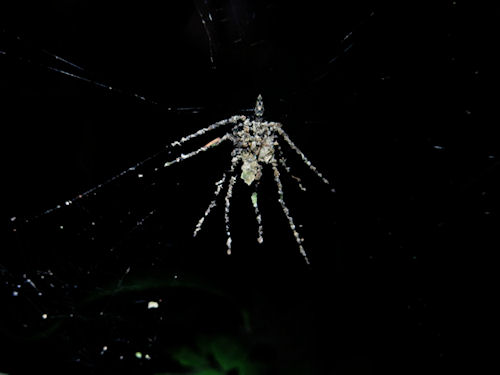
You’re walking through the woods and notice an interesting looking spider in the middle of its web from a distance. You decide to go in for a closer look. You make that ‘quizzical dog face’ because it’s a pretty weird-looking spider.
As you get closer, something seems a little ‘off’ about the ‘interesting’ spider…which begins to throb and shake in the most un-spider-like movement you’ve ever seen.
That’s about the time when your fear meter begins to spike as you realize the ‘spider’ you’ve been staring at is actually comprised of dead insects, debris and leaves and is being puppeteered by the real spider hiding just out of sight.
The ‘decoy spider’ is being looked at to see whether or not it’s a new species of spider or, in a step leading to total nightmare material, if it’s an already known spider that’s taught itself this behavior.
While scientists continue to determine what’s going on with this horrifying development in the spider kingdom, we’ll just keep hoping that human flesh is completely unpleasant to their terrifying little tastebuds.
Every year at the Waldorf Astoria in New York, the annual meeting of the Explorers’ Club takes place. One of the highlights of the event is the gala dinner and its infamous cocktail party which is like the more sophisticated and classy version of the dinner scene from Temple of Doom but with the same menu.
What’s the weirdest thing YOU’VE ever eaten? We’re curious to see just how weird the palettes of WeirdThings’ fans are.