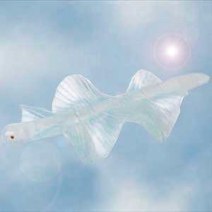
Could Japanese Earthquakes Have Aggravated Hoards Of Flying Cryptids?
Friday, October 21st, 2011
The Japanese earthquakes and resulting tsunamis dominated the news in early 2011 bringing horrifying picture of destruction and tragic loss of life. But in the rebuilding phase, a strange side effect emerged. Survivors of the disaster reported seeing a larger than usual amount of unexplained activity in the sky.
UFOlogists claimed it to be visitors from beyond surveying the damage on Earth. But one man has a different theory: flying cryptids have been unleashed over the Land of the Rising Sun.
The appearance of these atmospheric beasts varies wildly. Accounts have variously described them as amorphous and cloud-like behemoths, finned squid-like creatures, floating jellyfish, translucent, vaporous blobs, amoeba-like organisms, and even dragons. The sizes of atmospheric beasts likewise run the gamut from tiny and bird-like, to gargantuan monsters hundreds of feet long.
…The thing is that earthquakes and tsunamis influence more than just the Earth and the seas. When the powerful earthquake hit Japan on March 11, it not only jolted the Earth, but also shook the skies above. When earthquakes and tsunamis occur, they generate surface motion that in turn can trigger waves that can shoot up all the way to one of the highest parts of the upper atmosphere, to what is known as the ionosphere. These events are known as seismotravelling ionospheric disturbances.
Brent Swancer, writing for Cryptomundo, goes on to note that Japanese earthquakes in 2004 also triggers Sky Beast sightings.


I still don’t feel like I’ve completely managed to twist my mind around Kuchisake-onna. By extension, it’s likely that you haven’t either. If you’re deeply familiar with Japanese culture and society, you probably feel as though I’ve only brushed the surface of the legend, regurgitating all the requisite facts – slit mouth, surgical mask, vain inquisition and murder – without arriving at any real interpretive narrative insight save for another bogeyman rant and some tired Women’s Studies rhetoric that, itself, was plucked from an American curriculum. If, like me, your understanding of Japanese culture and society is wrested from a pack of cultural stereotypes and loose associatives – anime, game shows, Samurai and academically motivated suicides – Kuchisake-onna probably remains, quite literally, a ghost, a fanciful story, untethered from any definitive cultural prerogative or fixed history. I can confidently link the Bermuda Triangle to the New Age movement, to the UFO mania that began in the 1950s and to a curious fixation on Atlantis. Kuchisake-onna? All I can do is tell the story.
Popular folktales are just that – popular. And they belong to the populace in a way that few other types of media ever will. Like in any game of telephone, these whispered stories are just one subversive tongue away from being notably and untraceably altered. If parents can use fictions to manipulate a child’s fears to form a sort of behavioral corral, the child can use fiction to build a ladder over the fence or, better yet, smash the beams entirely. One kid says something; a few more repeat it, and pretty soon you’ve got mobs of little Asian children pelting hotties with Pocky. Or, at least, that’s what you get in the case of Kuchisake-onna. While smirking mothers berated their children with threats of slice-and-dicement at the scissor-wielding hands of the grinning curfew enforcement proxy, the children were spreading rumors that a defensively thrown stick of Pocky proves perfectly sufficient in warding off the hungry snippers of ol’ Slit-gob McCutty. No Pocky on hand? Don’t worry. There are plenty more head-scratching Kuchisake-onna evasion techniques.
Ancient, feudal Japan’s legends of proud warriors and disgraced Samurai haven’t always mixed well with contemporary urban legends and trendy pop cultural fads. The harakiri-inducing “Teenage Mutant Ninja Turtles III,” for example, found its titular rubber-suited pizza fetishists travelling back to 15th century Japan, where they pose as demons, fight an evil warlord and learn a valuable lesson about self-esteem. The legend of Kuchisake-onna, the grotesque and reviled slit-mouthed woman, however, gets the job done in both timelines. Bonus: some newer versions of the story sprint so far into left field that, by the time you realize the entire business is just another cautionary tale engineered to keep the ladies demure and the unaccompanied minors from running roughshod over the pachinko arcades, they’ve collided with the outfield wall.