Archive for the ‘History’ Category

Voynich Decoded?

Tuesday, December 15th, 2009


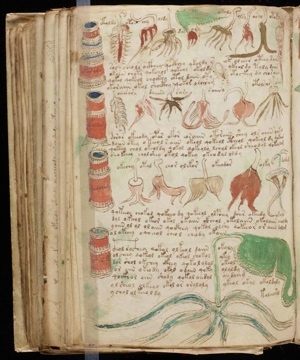
The Voynich manuscript, a mysterious medieval document that has confounded the best cryptographers for centuries may finally have been cracked.

A researcher studying the manuscript suggests that the secret coding may be anagrams created by a young Leonardo da Vinci? Does it sound far fetched? We’ll have to ask Harvard symbologist Robert Langdon…

Read: Voynich manuscript decoded?

Wikipedia


Live Bugs! Physical Violence! Cash! The Hunt For The Ultimate Haunted House

Wednesday, October 28th, 2009

All this week: Halloween urban legends – horrific truths, bald-faced lies, wild embellishments and insane speculations. On Monday, Matt explored the panic over tainted candy.

Today: Questing After Haunted House Eden

skitched-20091027-181249.jpgLike the lost city of El Dorado, or perhaps more appropriately like the profusion of rumored “midget towns” across the country, the ultimate haunted house attraction is an infamous and highly sought after fantasy destination. These rumored Halloween paradises aren’t advertised and move to a different hidden location every year. They’re generally described as multi-floored (anywhere from 3 to 13) warehouses run by mysterious, wealthy cabals. Some allegedly offer full refunds to anyone who can make it through the entire production (sometimes the refund is offered in installments paid out as a participant completes each floor). Of course, they’re so genuinely terrifying that no one has ever managed to reclaim the full entry fee.

Interestingly, unlike the diminutive midget towns, which always seem to be tucked away in unmapped corners of forgotten counties, these Edenic bastions of fright are generally rumored to exist in urban areas – warehouse districts or dilapidated portside neighborhoods. Fueling these stories is a suburban fascination with the city. A panic-tempered awe. A wonder-blanched fear. The middle school kids who look forward to annual jaunts through the plywood corridors of local Kiwanis-run haunted houses construct elaborate fantasies about said houses’ wild urban equivalents. The stories are built from an ingrained hyperbolic vision of the city as a concrete wilderness that’s at once less sympathetic, less polite, less controlled and, most importantly, more grown up than the familiar suburban landscape. Like a profusion of the message board posts debating the supposed locations of these hidden terrordomes state: “Half the fun is finding [the attraction].” By the very nature of the attraction’s non-existence, the search becomes the destination and the “ultimate haunted house” is actually the city streets as seen through the eyes of cul de sac sons and development daughters.

The richest version of the legend I could find was actually the one I grew up hearing: Somewhere in Philadelphia, PA is a 13-floor haunted house called, well, “13 Floors.” The first couple floors are rumored to be laughably standard haunted house fare; subsequent floors give way to trapdoors, complete darkness, live insects and reptiles, and, supposedly, violent physical assaults by masked assailants. Really, the whole thing unfolds into a beautiful allegory for growing up. The horrific, whispered climax of the story? Every year, the one or two participants who manage to successfully soldier on past the seventh or eighth floor are Never. Heard from. Again.

These few fearful, but brave, souls become the ghosts of suburban grade school legend. Neither living nor dead – just lost to the city. They matured into vapor. Grew up into steam. In truth, they are the ones who escaped.

Who Let The Hellspawn Dogs Out? Europe’s Demonic Canine Legends

Monday, August 24th, 2009

An eerie weather vane depicting a dog riding a bolt of lightning still stands atop the Suffolk church where, in 1577, an electrical storm propelled the specter of a black canine down into the holy sanctum. The apparition killed two praying supplicants and badly burned another before sublimating back into the amethyst sky and the roar of thunder.

From Hades’ babysitter Cerberus to the hound of the Baskervilles, dark canines have loyally heeled alongside European folklore and literature for centuries; the British Isles are uniquely overstocked with tales of skitched-20090824-034328.jpgsinister black dogs. Direct instruments of death, omens of misfortune and sentinels of the netherworld are among the most common vocations foist upon these ubiquitous ebon heck puppies (also called Hell Hounds or Grims), which are most often encountered during electrical storms or at places of transition – a dark silhouette at a crossroads, a black, starlit ghost in a cemetery or a pacing shadow, immune to moonlight, circling a hanging tree.

Dogs are natural scavengers with a heightened olfactory sense. Even in the wake of domestication, they are drawn to the blood and the meat of dead or dying animals, and pursue odors far too subtle for the human nose to detect. That this natural predilection toward, and ability to sense, the smell of the wounded and deceased – the very scent of death – could neither be trained nor bred out of them partially explains why they’ve historically been linked to supposed crossover spaces where the world of the living and the world of the dead bleed into each other like the soft-edged tendrils of colliding fog banks.

The idea of domestication itself, when paired with the already fevered imaginings of pre-enlightenment, Satan-phobic Western society, could have easily catalyzed tales devil dogs. When a blindly obedient animal can be taught to hone, focus and direct its strength, cunning and ferocity, it becomes an extension of its owner’s will. As man has always charged the devil and his minions with using man’s own free will, intellect and cunning against him, it’s no surprise that creatures like Cerberus and black dogs were imagined. After all, what’s more malevolent than co-opting the loyalty of man’s best friend and siccing the beast upon him?

The Britons’ nightmare of a loveable-mutt-turned-Beelzebub’s-PA proved indelible enough to survive the tumbling trek across the mighty Atlantic…

Wednesday: Black dogs and the American South

Spring Heeled Jack: A Fire-Breathing Terror For 19th-Century London

Tuesday, July 21st, 2009

Weird Things Culture Researcher Matt Finaly takes a weekly look into the social, political and cultural climates of a populace at the time it was affected by a legendary paranormal, extraterrestrial or cryptid phenomenon. It appears on Tuesdays…

skitched-20090721-130637.jpg

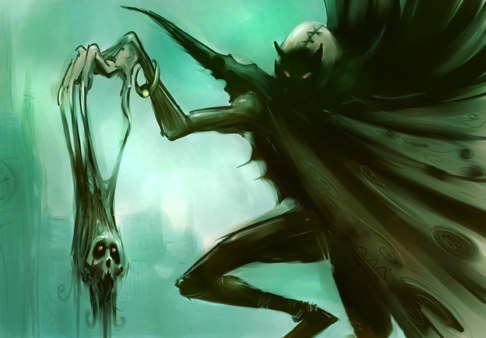
In 1837, something dark and quick began hunting women on the streets of London, pouncing upon them from the shadows and going to work on their clothes with razor talons and flaming breath, only to disappear seconds later, leaping silently over impossibly high hedges and rooftops, skitched-20090721-130406.jpgleaving behind only the shrill, hollow ghost of maniacal laughter and, of course, a panicked victim.
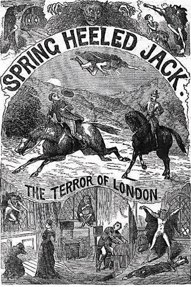
Descriptions of Spring Heeled Jack varied over the 65 years that he laid siege to London’s gas lit back alleys and dark urban bowers, but early witnesses (somewhat) consistently agree that he sported large pointed ears, an equally pointy nose, bulging eyes, sharp claws, the ability to breathe fire and a penchant for agile escapes via inhumanly powerful jumps (hence his media-coined moniker).

John Thomas Haines’ 1840 play, Spring-Heeled Jack, the Terror of London, marked the first official appearance of Jack in a popular entertainment (he had already become a staple of various Punch and Judy street puppet shows), which was followed by a rash of both sightings and corresponding sensationalized fictionalizations throughout the 1840s and ‘50s. In the name of both topicality and word economy, however, we aim to focus on the years prior to Jack’s assimilation into the everyday pop cultural dialogue of Victorian England.

Accepting, as many experts do, that the initial attacks between 1837 and 1838 were perpetrated by a still-anonymous (though one Henry de La Poer Beresford, dubbed “The Mad Marquess,” is a prime suspect) malicious, costumed prankster, and noting that the perpetrator’s image and misdeeds became the stuff of pop culture legend, the question must be posed: What overriding cultural factors contributed the specific physical attributes that the misogynistic hoaxer built into his monster? In short, why was a quick-footed, fire-breathing demon the obvious avatar for blind dread and mass hysteria in 19th century London?

(more…)

Did David Berkowitz, Leanord Nimoy & The U.S. Air Force Help Birth The Dover Demon?

Tuesday, July 7th, 2009

Tear Up The Town is a weekly column investigating the social, political and cultural climates of a populace at the time it was affected by a legendary paranormal, extraterrestrial or cryptid phenomenon. It appears on Tuesdays…

doverdemon.jpg.jpeg.jpg

For two warm spring nights in 1977, a monster trolled the quiet streets of Dover, Delaware, haunting passersby with its large, almost-featureless head and glowing, empty stare.

When one considers that none of the witnesses to the so-called “Dover Demon” (dubbed as such by the press) were in direct contact immediately before or after the alleged sightings, and all of their descriptions of the creature varied slightly (orange eyes versus green eyes, etc.), an orchestrated hoax skitched-20090707-000316.jpgseems unlikely. But a microcosmic case of teenage mass hysteria built around a confused infant moose and a pop cultural zeitgeist that piled a brand-new sensationalist Leonard Nimoy television program onto known UFO tracking at a local airforce base, a rampaging serial killer and an imminent star war?

Many skeptics believe it isn’t a coincidence that all three witnesses (Bill Bartlett, age 17; John Baxter, age 15; and Abby Brabham, age 15) to the spindly, large-eyed, four-foot-tall, melon-headed creature, which was witnessed clambering along Dover roadsides on April 21st and 22nd, 1977, were adolescents; even after disregarding the high school prank theory, some experts believe the Dover Demon, a veritable celebrity among American cryptids, was probably a woefully misidentified baby moose. Others admit the possibility that it could have been the product of a covert genetic engineering experiment. Sure, certain spirit hunters and cryptophiles with a new-age bent believe that the witnesses’ age demographic suggests that the alleged creature was related to a poltergeist, appearing only to those whose hormones and bio-rythyms were in continuous flux, and phrases like “extra-terrestrial” and “inter-dimensional being” have been tossed around, but the same trixy pubescence that collectively robs the witnesses of credibility also helps explain how a demon was born.

(more…)

Creepy Bird Masks of the 14th Century

Wednesday, May 13th, 2009

plaguemask
Image Credit: j_naturalia_2

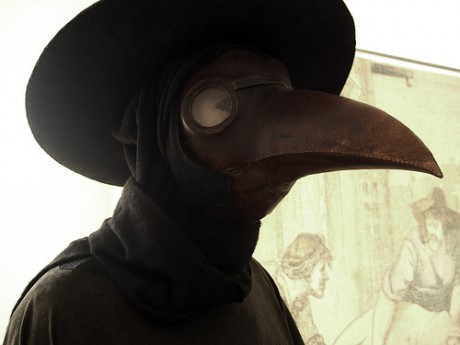
We know what you’re thinking, and no the Bird People have not decided to rise up against their human overlords….yet. The photo above depicts an individual fashioning the get up Plague Doctors wore when visiting patients during the Black Death in the 14th Century.

1/3 of the population of Europe was wiped out by the plague and the costume definitely reflects the creepiness of the times. Plague Doctors wore the frightening get up to mitigate their chances of catching the highly infectious disease, think of it as an archaic hazmat suit.

(more…)

World War 2 UFO Footage

Thursday, April 16th, 2009

1 minute and 48 seconds into the above video you see a strange ball of light that appears to leap across the screen from one grouping of clouds to another just as the plane is taking off from the aircraft carrier. This video is being touted on youtube as proof of UFOs. But is the freaky ball of light an object in the sky or something much closer to the camera?

Why teenagers make bad Popes

Wednesday, April 16th, 2008

pope

Gambling, incest, whorehouses, invoking the devil and Jupiter, our modern day troublemaking celebrities have nothing on Popes of a bygone age. Check out this account of the teenaged Pope John XII (elected at 18, pope from 955 – 964). FYI, his dad, Albrec the II got him the gig.

Then, rising up, the cardinal priest Peter testified that he himself had seen [John XII] celebrate mass without taking communion. John, bishop of Narni, and John, a cardinal deacon, professed that they themselves saw that a deacon had been ordained in a horse stable, but were unsure of the time. Benedict, cardinal deacon, with other co-deacons and priests, said they knew that he had been paid for ordaining bishops, specifically that he had ordained a ten-year-old bishop in the city of Todi… They testified about his adultery, which they did not see with their own eyes, but nonetheless knew with certainty: he had fornicated with the widow of Rainier, with Stephana his father’s concubine, with the widow Anna, and with his own niece, and he made the sacred palace into a whorehouse. They said that he had gone hunting publicly; that he had blinded his confessor Benedict, and thereafter Benedict had died; that he had killed John, cardinal subdeacon, after castrating him; and that he had set fires, girded on a sword, and put on a helmet and cuirass. All, clerics as well as laymen, declared that he had toasted to the devil with wine. They said when playing at dice, he invoked Jupiter, Venus and other demons. They even said he did not celebrate Matins and the canonical hours nor did he make the sign of the cross.

The Wikipedia entry on Pope John XII