Archive for the ‘Ancient Civilizations’ Category

Ancient Remains Found Near Stonehenge Belonged To Tourist

Friday, October 1st, 2010

skitched-20101001-140541.jpg

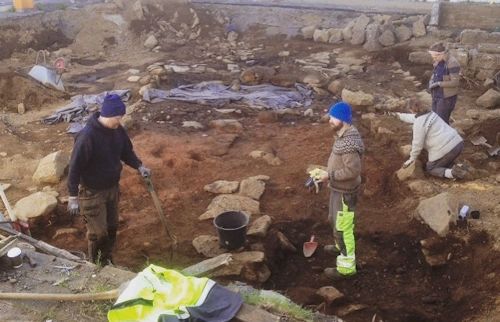
Even back in the day, Stonehenge was a tourist trap. One of the oldest human remains found near the site was identified as having Mediterranean origins.

The British Geological Survey’s Jane Evans said that the find, radiocarbon dated to 1,550 B.C., “highlights the diversity of people who came to Stonehenge from across Europe,” a statement backed by Bournemouth University’s Timothy Darvill, a Stonehenge scholar uninvolved with the discovery.

“The find adds considerable weight to the idea that people traveled long distances to visit Stonehenge, which must therefore have had a big reputation as a cult center,” Darvill said in an e-mail Wednesday. “Long distance travel was certainly more common at this time than we generally think.”

Of course people travelled long distances, what else where they going to do without internet or TV? Watch each other’s hair grow?

It would be so easy to get me to go on a 2 month boat trip back then. “Hey were going to see a cult center in the north country, you might die and we’ll probably run out of food but at the same time it’s going to be a couple dozen centuries until someone invents an iPhone… so you in?”

[AP]

Fossil Of Terrifyingly Toothy Bird Found

Thursday, September 16th, 2010

skitched-20100916-121822.jpg

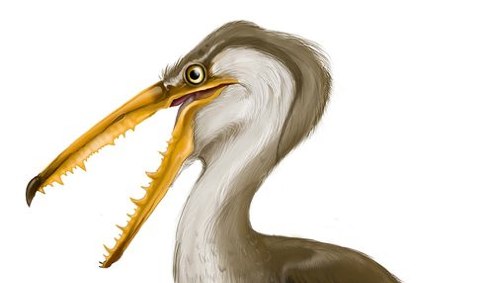
The figure of pure terror you see before you is not the mascot of an arena league football team. Rather, it’s the artist rendering of an ancient seabird which once roamed modern-day Chile. Fossils of the creature were recently discovered just in time for nightmares to begin.

Thanks to Weird Things reader Darcy for the tip.

[Nat Geo]

How A Dead Sorcerer Began The Concept Of Feasting For The Deceased

Tuesday, August 31st, 2010

skitched-20100831-115901.jpg

The oldest known shaman died and was buried in a Northern Israeli cave. Everyone thought it would be a good idea to stuff their faces with food in her memory. Because of this, you ate a ham plate at your Uncle Barry’s wake.

Life is strange.

A study published Monday in the journal Proceedings of the National Academy of Sciences by Grosman and Natalie Munro, a zooarchaeologist at the University of Connecticut, reveals that the shaman’s burial feast was just one chapter in the intense ritual life of the Natufians, the first known people on Earth to give up nomadic living and settle in villages.

The other traditions? Carried the dead bodies along with the party supplies up the mountains to their elevated resting places. Who’s got two thumbs and is pretty psyched we dropped that one?

[Nat Geo]

There It Is! Letter Recovered After 400 Years Contains Secret Language

Friday, August 27th, 2010

_Lost_ Language Found on Back of 400-Year-Old Letter.jpg

A letter found in the ruins of a collapsed Spanish colonial church in Peru could be the key to a heretofore undiscovered language. Awesome.

“Even though [the letter] doesn’t tell us a whole lot, it does tell us about a language that is very different from anything we’ve ever known—and it suggests that there may be a lot more out there,” said project leader Jeffrey Quilter, an archaeologist at Harvard’s Peabody Museum of Archaeology and Ethnology.

The letter was preserved because the caved in structure protected the relatively unharmed library and offices of the facility.

[Nat Geo]

Mayans Might Have Created Artificial Lakes

Thursday, August 26th, 2010

skitched-20100826-181317.jpg

Researchers have found that Mayans protected their drinking water by installing a layer of ceramic shards. Pretty crafty…

If so, that would be a minor sensation — merely due to the quantity of ceramics required. The aguadas in Uxul were each as large as ten Olympic-size pools. Maybe there used to be even more artificial lakes. After all, the precious commodity had to be enough to last a population of at least 2,000 through the 3-month dry season.

Mayans! What will they have thought of next!

3-D Model Recreates Living Blob Which Used To Prowl The Oceans

Wednesday, August 4th, 2010

skitched-20100804-153303.jpg

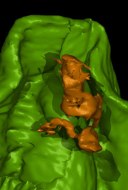
It meandered about the sea, a living blob named Drakozoon kalumon. Surviving by glomming on to other creatures and surviving on the tiniest morsels of food, this 1.7 millimeter creature was protected by a leathery outer skin bigger than it’s own body.

Until it was imprisoned in volcanic ash for 425 million years. But now, Drakozoon is back! Or at least a 3-D model of him is.

Its two coiled arms likely did the work of feeding. “If it worked like a brachiopod, and I suspect it did, it would have used fine setae (hairs) on the arms to generate currents, catch tiny pieces of food in the seawater, and pass them down the arms into the waiting mouth,” Sutton told LiveScience.

The preserved blob was attached to the fossilized shell of a type of spineless shellfish known as a brachiopod. Researchers made the discovery about six years ago in the Herefordshire Lagerstatte, one of England’s richest deposits of soft-bodied fossils.

Doesn’t Drakozoon kalumon just sound like it needs to be chanted by an evil mastermind trying to resurrect some Lovecraftian leviathan? Just asking.

[Live Science]

The Mysterious Wooden Stonehenge… Of Cincinnati?

Thursday, July 22nd, 2010

skitched-20100722-115925.jpg

A ceremonial ground designed by a long-gone culture to mark and celebrate the lunar cycles… just over the river from modern-day Kentucky.

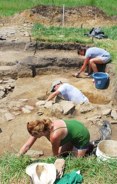
This year archaeologists began using computer models to analyze Moorehead Circle’s layout and found that Ohio’s Woodhenge may have even more in common with the United Kingdom’s Stonehenge than thought—specifically, an apparently intentional astronomical alignment.

The software “allows us to stitch together various kinds of geographical data, including aerial photographs and excavation plans and even digital photographs,” explained excavation leader Robert Riordan, an archaeologist at Wright State University in Dayton, Ohio.

If this isn’t somehow referenced in a Chad Ochocinco touchdown celebration this season, we will be very disappointed. Child please.

[Nat Geo]

How First-World Bias If Not General Racism Created The Artwork Of Atlantis

Tuesday, June 22nd, 2010

The African sculptures mistaken for remains of Atlantis - CNN.com.jpg

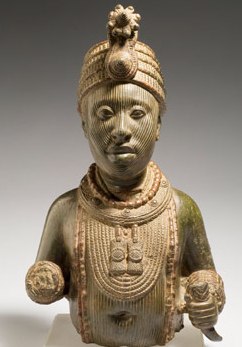
German explorer Leo Frobenius came to West Africa and made a startling discovery. Gorgeous statues cast in exquisite bronze. So intricate, so beautiful, they so could not be the work of the locals. No, of course not. They simply had to be the handiwork of the lost city of Atlantis. Finally! Proof had washed upon the shores of modernity!

Or not. Turns out the statues were, in fact, created by the locals. Oops.

In his book, Voice of Africa, Frobenius wrote: “Before us stood a head of marvellous beauty, wonderfully cast in antique bronze, true to the life, incrusted with a patina of glorious dark green. This was, in very deed, the Olokun, Atlantic Africa’s Poseidon.”

“I was moved to silent melancholy at the thought that this assembly of degenerate and feeble-minded posterity should be the legitimate guardians of so much loveliness,” he added.

Frobenius was referring to the people who lived in the Kingdom of Ife and whose artists, in fact, created the sculptures over the course of some four centuries. Leading art experts believe they are among the most aesthetically striking and technically sophisticated in the world.

The sculptures are now on display at the Museum of London, after which they come to the United States.

[CNN]

Human Sacrifice: Ancient Chinese Secret, Huh?

Monday, June 21st, 2010

Photos_ Human Sacrifices Found at Ancient China Complex.jpg

New archeological evidence proves that the China’s Western Zhou dynasty dabbled in human sacrifice roughly 2,700 years ago.

“In general, there’s been a tendency to describe Western Zhou as a more humanistic period, when the practice of human sacrifices”—which were commonplace during the preceding Shang Dynasty—”were waning,” Sena said.

“But I think the archaeological evidence shows quite clearly that human sacrifices persisted throughout the Zhou period as well.”

So now we know.

[National Geographic]

Were Legendary Japanese Race Dwarves, Pygmies Or Hobbits?

Wednesday, June 9th, 2010

skitched-20100609-180303.jpg

Legend tells of an intensely insular, physically tiny race that lived in the north of Japan thousands of years ago before humans settled there. Brent Swancer of Cryptomundo takes a fascinating look at who they were and why they might be closer to hobbits than modern day dwarves.

[Cryptomundo]

Were The Earliest Human Species Cannibals?

Thursday, May 27th, 2010

A new finding suggests the earliest known human species swung from trees had the tools to make fire and was likely fond of eating other hominins.

Yummo.

The H. gautengensis fossils were found alongside basic stone tools and evidence of the use of fire. The most complete human ancestor skull from the sediments associated with H. gautengensis is a widely studied mid-1970s discovery labeled Stw 53.

The stone tools would have been used for “‘de-fleshing’ and cutting open bones to access marrow, and probably also for digging and [preparing] plant foods,” he said. “They might also have been used for processing animal hides.”

Cut marks on the Stw 53 skull hint at darker practices—”that it was de-fleshed, either for ritual burial or cannibalistic consumption.”

There is some really fascinating stuff (including more detail on how primitive tools were used to de-flesh things) in the this article so please read it.

[National Geographic]

Remains Of Human Sacrifices Opens Window Into Lost Civilization

Thursday, May 20th, 2010

Pictures_ Pyramid Tomb With Human Sacrifices Found.jpg

As it turns out, rolling with the Zoque over 2,700 years ago was pretty touch and go. On the upside, you were an off-shoot of the Olmec and were therefore among the first modern civilizations in recorded history. On the downside, you might end up in a Mexican pyramid with a mouth full of jewels and a face smeared with pigment as you complete your roll as a human sacrifice only be be discovered in 2010 by a Brigham Young University archeologist.

The remains of an elite child and adult were recently excavated, giving researchers a look at how the culture operated.

[National Geographic]

Silver Lining To Recent Flood Victims, It Could Have Been A Megaflood

Thursday, May 6th, 2010

skitched-20100506-143102.jpg

With all the talk of flooding in Tennessee, it helps to look back into history to gain perspective. After all, at least it wasn’t the megaflood that completely redefined that Alaskan landscape 15,000 years ago.

One of at least four megafloods from ancient Glacial Lake Atna, the deluge breached ice dams and covered more than 3,500 square miles (9,065 square kilometers) of land of what is today the Copper River Basin northeast of Anchorage. (The lake would’ve covered Rhode Island three times.)

Megafloods by definition have a flow of at least 264 million gallons of water per second (1,000 million liters of water per second). The largest known freshwater megaflood released about 4,500 million gallons of water per second (17,000 million liters of water per second) and originated out of Glacial Lake Missoula in Montana.

The megaflood from Atna likely had a flow of about 792 million gallons of water per second (3,000 million liters of water per second), and released a total of as much as 336 cubic miles (1,400 cubic kilometers) of water – enough to cover an area the size of Washington, D.C., to a depth of 5 miles (8 km).

So, at least they have that going for them.

In all seriousness, if you’d like to help by donating money or time to the relief effort in Tennessee, head here for more information.

[Live Science]

A Worldwide Hunt For Oddities Summarized In One Video

Friday, April 23rd, 2010

Pretty self-explanatory. Big ups to Atlas Obscura!

Is this what’s left of the Lost City of El Dorado?

Wednesday, February 10th, 2010

Deep in the Amazon researchers are exploring the remnants of a city that dates back to 200 AD. Little is known about the inhabitants and some speculate that this could have been the source of the rumors of El Dorado. Click through for the video. Scientific American


The Horrifying Twist To Avatar You Didn’t See

Tuesday, January 12th, 2010

Since this edition of The Twist, in which Matt Finley adds a wholly unnecessary narrative spin to the satisfying, straight-forward conclusion of a film. features SPOILERS to a movie that is still in theaters we are putting the entire post AFTER THE JUMP. In case this is not clear, AFTER THE JUMP there are SPOILERS about the movie Avatar.

(more…)