Archive for the ‘TV Versus Weird Things’ Category

Ghost In The Machine: Batman & Midnight Society Tackle TV’s Toughest Demonic Electronics

Thursday, August 6th, 2009
afraidpic2.jpg.jpg

In this column, we look at two pop-cultural interpretations of ubiquitous Weird legends as portrayed by two narrative television programs… like how Buffy the Vampire Slayer’s Rupert Giles and Inspector Gadget’s Penny would both be nothing without magic books. But with monsters. Enjoy.

Are You Afraid of the Dark?, Episode 1×13, “Tale of the Pinball Wizard”

And

Batman: the Animated Series, Episode 1×45, “What is Reality?”

Every major technological trend or development is always addressed by pop culture with a movie or show that illustrates the breakthrough’s potential for wild mass homicide. What if a VHS tape… were haunted? What if your cell phone… were haunted? What if the Internet… were haunted? The stereotype is that all of these sorts of properties emerge from Japan – after all, my above examples come from The Ring, One Missed Call and Pulse, all American re-makes of popular Japanese horror films. But one really only need to look back as far as the early ‘90s to find a time when North America was just as obsessed with fashioning some sort of fiber optic bogeyman (e.g., films like The Net and Lawnmower Man) with which to sop up all the technophobic cold sweat breaking out over things like the Internet and the promise of virtual reality. The root of this fear stems from people’s inability to comprehend exactly how invisible information is stored, transmitted and received, and their dread that individuals who do understand, or ghosts, who are also invisible and are, therefore, somehow viewed as computer compatible, can take advantage of that mystery to exploit society’s reliance on technology.

Batman: The Animated Series and Are You Afraid of the Dark? both crafted technology-centered episodes, specifically predicated upon the largely parental fear of addictive escapism in the form of video games. The episodes were released only one year apart (Tale of the Pinball Wizard in 1991 and What is Reality? in 1992), and each seeks to address the ubiquitous modern concern that people are using electronic entertainments to escape their actual lives by entering false realities that they either command or are able to conquer. One of these episodes comes down firmly on the side of irrational parents, engaging in lengthy finger wagging session that lays out the addictive nature of gaming and the ultimate physical price that comes with it. The other episode is, thankfully, a staunch defender of kids, recognizing that, while it’s true that people can’t occupy a world that they control, and shouldn’t try to, they can still embrace the fact that, ultimately, they have complete control over themselves.

(more…)

Futurama, Tales From The Crypt & The Werewolf In Modern Society

Thursday, July 30th, 2009
HowlOfTheWerewolf.jpg

In this column, we look at two pop-cultural interpretations of ubiquitous Weird legends as portrayed by two narrative television programs… like how The Closer’s Brenda Johnson and The Muppet Show’s Janice both stockpile excess grrl power in their lips. But with monsters. Enjoy.

This week:
I am the werewolf

Tales from the Crypt, Episode 4×13, “Werewolf Concerto”

And

Futurama, Episode 2×18, “The Honking”

Whether they’re eviscerating innocents or surfing atop speeding vans, werewolves play an integral role in the over-active dream life of the human world; they are an indelible personification of the perpetual internal pugilism between ego and id that holds civilization in tenuous balance between perfection and collapse. Humanity, as contemporary society understands it, is a volatile potion derived from a combination of the instinctual primacy of natural functions and hierarchies, and the imposed order of an invented ethical and social structure. Over the centuries, tales of lycanthropy have been used to represent the eternal ego/id conflict in a variety of venues, including mental illness and human sexuality. After all, unlike vampires, demons or yetis, werewolves are full-time humans who only moonlight as monsters, going feral when the extant animal mechanisms inside them are activated, forcing them to tear through the binding fabric of civilized clothing and run howling out into the world with all the anger and force of a captured animal finally loosed from its cage.

Tales from the Crypt and Futurama both take incisive looks at very different aspects of the curse of the werewolf. Both delight in some of the legend’s traditional trappings – the stark pain of transfiguration, the who-dunnit paranoia of knowing someone in the room is harboring a beast within – while exploring different, but in no way mutually exclusive, facets of the larger ramifications of lycanthropy in the modern age. One episode travels down the well-worn path of the werewolf as male sexuality gone awry, before taking a sharp turn that provides an answer to the reckless pubescent violence of repressed masculinity. The other seeks to acknowledge the co-dependence that the wolf exhibits towards the very system that it longs to devour.
(more…)

How Star Trek, Kolchak Used Supernatural Excuses To Explain Jack The Ripper

Thursday, July 23rd, 2009
skitched-20090723-134634.jpg

In this column, we look at two pop-cultural interpretations of ubiquitous Weird legends as portrayed by two narrative television programs… like how Bones’ Angela and Six Feet Under’s Olivier both use art to explore distant, uncharted regions of the human capacity for being annoying. But with monsters. Enjoy.

This week:
Jack

Kolchak: The Night Stalker, Episode 1×01, “The Ripper”

And

Star Trek, Episode 02×14, “A Wolf in the Fold”

For two and half months in the latter half of 1888, Jack the Ripper prowled the brothels and boarding houses of London’s seedy Whitechapel district, killing and mutilating at least five prostitutes with brutal aplomb. The Ripper was never captured and, over the course of the last century, the list of possible suspects has grown to contain the names of over 100 people, ranging from abortionists to cobblers to known confidence men.

While it’s increasingly likely that detectives and pathologists will never uncover the true identity of one of the world’s most notorious serial killers, Hollywood has continually stepped in to offer fantastical solutions.

If there’s one service that pop culture dutifully provides, it’s the declawing of society’s fiercest bogeymen by strapping them down into three-act structures and onychectomizing them with sharp dialogue and steady-handed denouements.

These episodes of Kolchak: The Night Stalker and Star Trek are quintessential examples of popular storytelling providing the solace of a solution where real life finds none and, in doing so, offering the viewer a false sense of comfort and security. The anonymity of Jack the Ripper is why he has endured as an elusive, frustrating and terrifying cultural enigma; he is an abstract, at once man, monster and ghost – a human driven to inhuman deeds, who then disappeared into the ether of nightmares before his true face was revealed. Fortunately, the first step storytelling takes to allay our deepest terrors is the provision of a monstrous physical form that can then be attacked and conquered by the brave and the savvy and the attractive. It’s in this aspect – personification – where these shows choose radically divergent paths, while still managing to arrive at a similar and wholly unsatisfying brand of succor.
(more…)

Demonic Scarecrows Prove Common Remedy For Panicked TV Famers

Thursday, July 16th, 2009

In this column, we look at two pop-cultural interpretations of ubiquitous Weird legends as portrayed by two narrative television programs… like how Battlestar Galactica’s Colonel Tigh and Pushing Daisies’ Aunt Lily both use an eye patch to eliminate the burden of depth perception from their delirium tremens. But with monsters. Enjoy.

This week:
“Don’t be silly, Toto. Scarecrows don’t talk.”

Friday the 13th: The Series, Episode 1×11, “Scarecrow”

And

Supernatural, Episode 1×11, “Scarecrow”

On the most basic level, the scarecrow is a symbol of protection – an untiring sentry standing watch over a working family’s livelihood. The idea of creating something in the image of man, of manipulating raw Earth or plant matter into human form, of shaping around that form a mission or purpose to be carried out in the creator’s stead, is the stuff of golems (And if pop culture has taught us anything about golems, it’s that the only thing worse than a wild golem loosed recklessly by a careless hand is a controlled golem conducted maliciously by a steely one).

The transition of the scarecrow from the symbol of protection that it represented to our European ancestors to the glowering potential death omen it has since become has everything to do with the cultural shifts that occur when a communally centered agricultural ideology is overpowered by a system of industrial capitalism, and the fear that fading agricultural segments of that industrialized society will employ drastic measures to force an unpredictable, uncontrollable entity (the Earth) to function with the same consistency as wholly programmed and regulated entity (a machine). Drastic measures like, say, golems…

(more…)

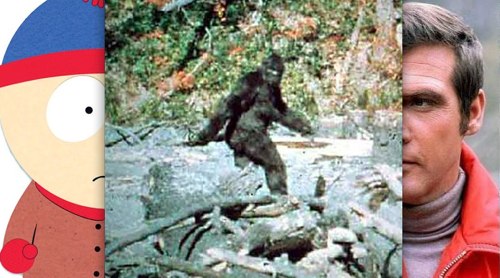
South Park & Six Million Dollar Man Reveal Bigfoot As Lovable American Icon

Thursday, July 9th, 2009
Bigfoot.jpg.jpg

In this column, we look at two pop-cultural interpretations of ubiquitous Weird legends as portrayed by two narrative television programs… like how Sam Malone on Cheers and Al Swearengen on Deadwood both manipulated the politics of an entire town from behind the counter of a bar. But with monsters. Enjoy.

This week:
“Bigfoot is blurry.”

South Park, Episode 1×03, “Volcano”

The Six Million Dollar Man, Episodes 3×16 and 3×17, “The Secret of Bigfoot”

Bigfoot has always occupied a unique place in the pantheon of American cryptids. And I use “American” very deliberately here to suggest that, while sasquatches and yetis and abominable snowmen are found (and feared) the world over, Bigfoot is a specifically American cultural institution. Even the name “Bigfoot,” a simple, almost cute, descriptive moniker, suggests what ultimately seems to be the larger mystery that Americans wrestle with when they ponder the elusive, hirsute giant. It isn’t “Is he fact or fiction?,” but rather “Is he friend or foe?”

Both South Park and The Six Million Dollar man mused upon this question. One employed the query in revealing larger truths about pop culture’s grip on folklore. The other simply provided an answer… a weird, ridiculous answer.

(more…)

Buffy, Mulder & Scully Versus Frankenstein

Wednesday, July 1st, 2009

frankenstein-jj-001.jpg.jpeg.jpg

In this column, we look at two pop-cultural interpretations of ubiquitous Weird legends as portrayed by two narrative television programs… like how Walter on Fringe and the eponymous Gilmore girls repeatedly explored binge eating as a salve for intellectual fatigue. But with monsters. Enjoy.

This week:

“I heard a Frankenstein lives there!”

The X-Files Episode 5×06 – “The Post-Modern Prometheus”

Written by show creator Chris Carter

Buffy the Vampire Slayer Episode 2×02 – “Some Assembly Required”

Written by Ty King

The classic story of Frankenstein has been reinterpreted through the catch phrase-addled, boob-frenzied lens of pop culture over and over and over again. Just when you thought the premise was dead, some mad scientist of a producer resurrects it against the will of God and allows the resulting hideous perversion to rampage through prime time all over again. Two of the most lauded modern genre shows, X-Files and Buffy The Vampire Slayer each took a stab at the story, but only one truly broke new ground on the legend.

(more…)