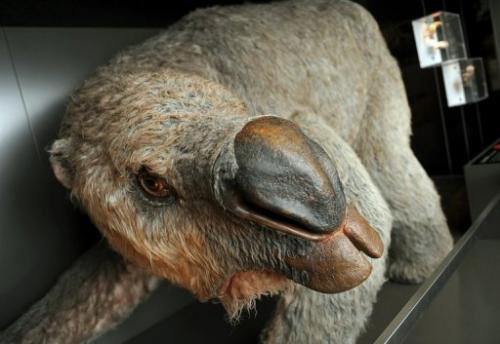
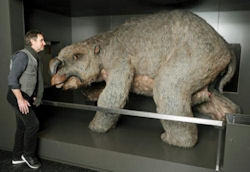
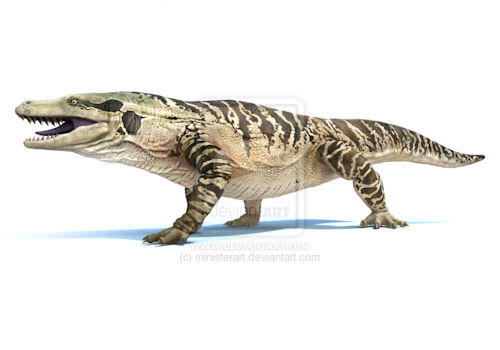
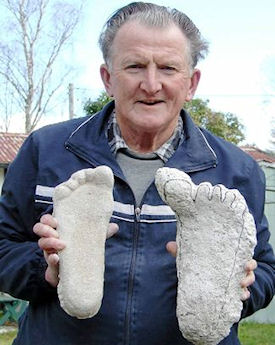
Animatronic Dinosaurs Roam Australian Museum
Wednesday, February 1st, 2012If you don’t scare the children how will they learn?
If you don’t scare the children how will they learn?
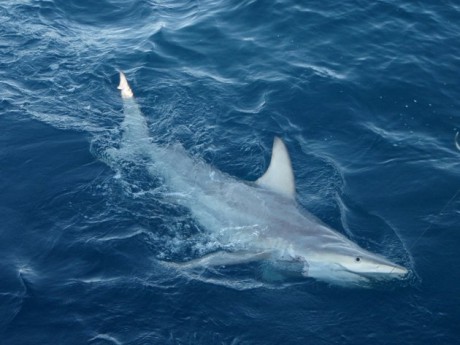
The world’s first hybrid shark was discovered off the coast of Australia containing both common and Australian black tip DNA, with up to 20% percent of the population sampled being hybrids. Scientist speculate that the hybridization increases the range that the sharks can survive and could be a result of changing sea temperatures.
The mating of the local Australian black-tip shark with its global counterpart, the common black-tip, was an unprecedented discovery with implications for the entire shark world, said lead researcher Jess Morgan.
“It’s very surprising because no one’s ever seen shark hybrids before, this is not a common occurrence by any stretch of the imagination,” Morgan, from the University of Queensland, told AFP.
“This is evolution in action.”

In an effort to be accepted by their peers, dolphins located in Western Australia’s Shark Bay have been spotted “conching.” What is conching? Conching is a method used to catch fish by trapping them in a conch shell, bringing that shell to the surface and shaking that shell with your beak inside the conch so that the fish falls into your mouth. The curious part of conching is that this appears to be a learned behavior that other dolphins are observing and mimicking. Early conchers were doing this as early as 2007 but in the last four months there have been as many as seven documented conching instances. There is still much speculation as to the actual technique used underwater as scientists have only been able to observe “conching” from the surface.
“That’s significant on a few levels. For one, we already know dolphins are very intelligent creatures, but a horizontal spread of a learned behavior at this rate is pretty off-the-charts. Moreover, scientists appear to have gotten in on this fad at the ground floor (they were observing dolphins conching way before it was mainstream, bro), so they have the opportunity to observe this learned behavior as it spreads.”
Aboriginal mythology tells of an aquatic demon called a “bunyip” that haunts Australia’s riverbeds and marshes, lurking silently beneath the water’s shimmering surface, waiting to devour or drown any careless passersby. At night, the bunyip’s fierce roaring call sounds out across the black, hollow veil of darkness, rousing children from slumber and echoing through the dreams of adults.
According to the traditional folklore of various tribes, the bunyip has a dog-like head, walrus tusks, seal flippers, a furred torso and a horse tail. Sometimes also feathers. Or scales. It has also been described as a giant snake with a wild, tattered mane and as a half-human monster with a long neck and the head of a bird. There isn’t much consensus.
The creature’s tribe-to-tribe physiological variants underscore an interesting aspect of mythology – the biological attributes of legendary monsters are far less important to their existence than the socio-cultural service the beasties offer. The bunyip, for example, boasts as many physical variations as it does alleged sightings, but one detail remains consistent – its predilection toward dragging hapless Aborigines into streams, swamps and billabongs. The tale of the bunyip, then, has less to do with compiling a thorough dossier of Australia’s supernatural threats than with creatively imparting children with cautionary advice and containing the chaotic, imposing enigmas of the natural world within a comfortable, familiar narrative. Whether a bird-headed humanoid or a tusked snake, by keeping kids away from the crocodile-laden waters of Australia’s rivers, the bunyip helped prevent drownings and other gruesome deaths. It also, as evidenced by the many terrified descriptions of the animal’s nighttime vocalizations, offered tribes an explanation for the many unexplained sounds that issued out, distant and haunting, from wild dark glens and black lakes.
In the 1800s, the bunyip took on an entirely new cultural significance – as an example of the way Britain co-opted and Westernized the folklore and traditions of its colonies. In typical European fashion (as evidenced in America by the transmogrification of Native American mythology from symbolic representations of the aspects of nature to horror stories about colossal birds and sea serpents), the bunyip was immediately removed from its cultural context and literalized. The story promised more than ethnographic insight into an unfamiliar indigenous civilization – it promised a marvelous new animal.
Wednesday: The Great Victorian Bunyip Hunt