Marine scientists that had set out on an expedition to explore seepage of methane gas along the eastern coastline as well as looking for their mooring from previous visits to the area were surprised when they caught of sight something they did NOT expect…
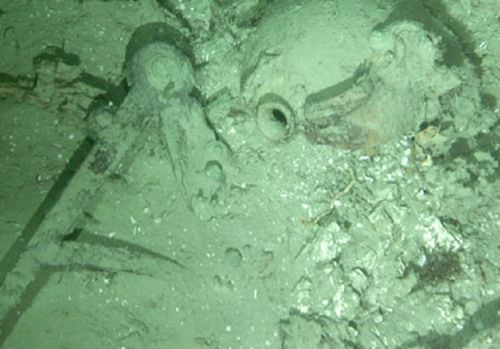
An old, aged chain running along the bottom of the ocean about 100 miles from the coast of North Carolina and one mile from the surface.
Using submersibles and sonar, scientists were excited to discover it was attached to a boat…
A very old boat.
Several artifacts including bottles, jars, the ship’s compass and sextant have been photographed just lying on the ocean floor around the wreckage.
Located well beyond an area known as the “Graveyard of the Atlantic” researchers believe that the ship was used in trading. Research and dating will be carried out by NOAA to determine just how old the boat is and its importance, if any, to history.
Cindy Van Dover, director of the expedition:
“This is an exciting find, and a vivid reminder that even with major advances in our ability to access and explore the ocean, the deep sea holds its secrets close.”
Posted in Abandoned, Archaeology, Ocean, Shipwreck | Comments Off on 18th Century Shipwreck Accidentally Discovered – 100 Miles Off the Coast of North Carolina
BEFORE you press play on that video (we’re sure some of you just went for it anyway) put down whatever it is you’re eating.
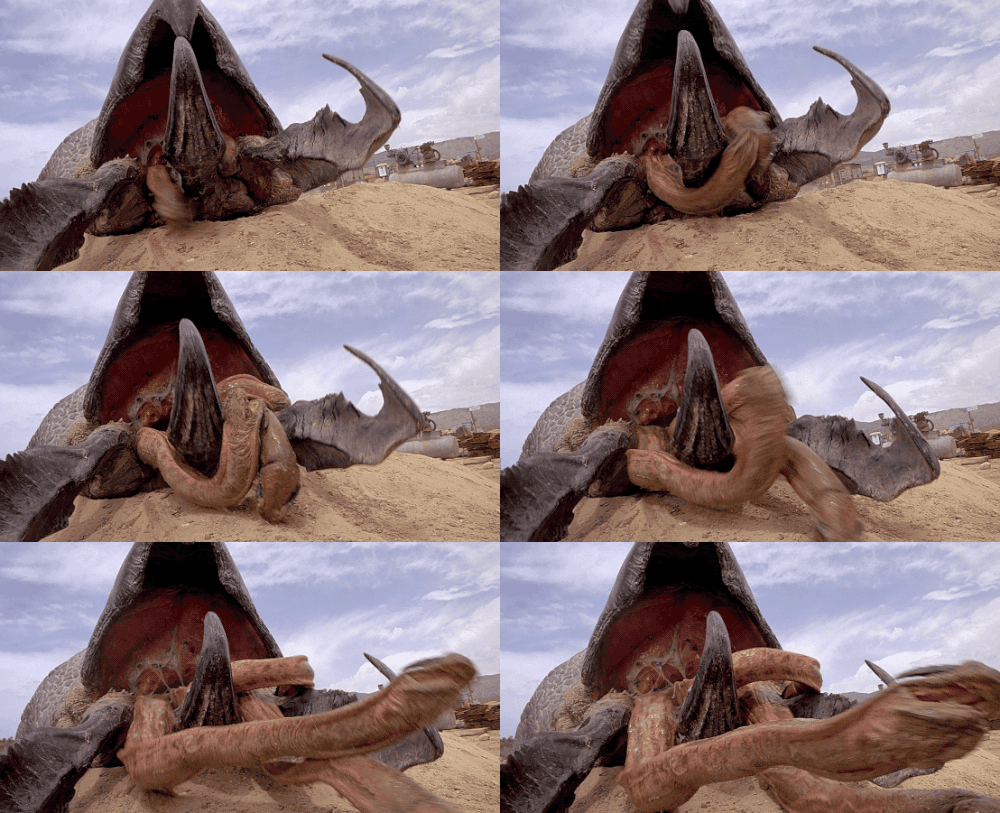
This is a ribbon worm called a Gorgonorhynchus. When it senses nearby prey it launches what looks like a root out of its face. Anything caught in those flinchingly terrifying ‘roots’ get hauled into the worm’s belly.
That nightmarish thing in the photo above isn’t a screen-used graboid prop from Tremors.
Nope.
That’s an actual creature that lives in our oceans…you know…that giant mass of water that you swim in when you vacation?
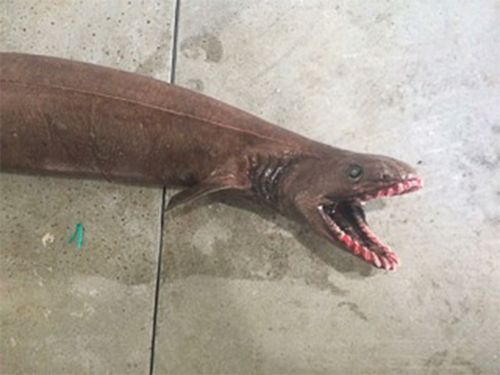
Caught off the coast of Australia by a fishing trawler, that thing is a six-foot long monster known as a frilled shark.
Frilled sharks haven’t evolved in almost 80 million years simply because a nightmare is always going to be a nightmare. On very rare occasions frilled sharks are found close to the surface because they’re dying. “Close to the surface” is around 4,000 feet below the surface.
Simon Boag of the trawling company that caught the creature:
“It does look 80 million years old. It looks prehistoric. It looks like it’s from another time! It has 300 teeth over 25 rows, so once you’re in that mouth, you’re not coming out.”
According to a marine conservation society in California there is a report of a frilled shark from 1880 measuring in at 25 feet.
Next time you go splashing around in the ocean for fun just remember…
Robots. We just can’t stop building them even though countless movies tell us where it’s all headed. Not only can we not stop trying to emulate ourselves mechanically, a small portion of the robotics community can’t stop trying to emulate creatures from the animal world.
One of the latest creations by a group called FORTH (Foundation for Research and Technology-Hellas) is a tiny little robot trying to emulate the natural actions of octopi and squid.
The video above showcases the features and development of the robot as it goes from having bare legs to more efficient webbed legs to carrying an object in a couple of its legs (check out the little yellow ball it’s carrying) to going for a swim out among more natural life in the actual ocean.
It’s fascinating and almost relaxing to watch as it pulses through the water.
Relaxing until someone attaches tiny laser-guided torpedoes to it.
They’ve taken on Moby Dick, Captain Nemo’s Nautilus and even a bunch of Goonies.
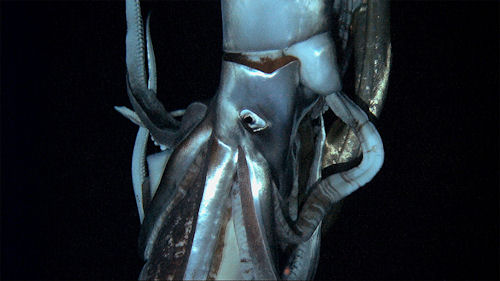
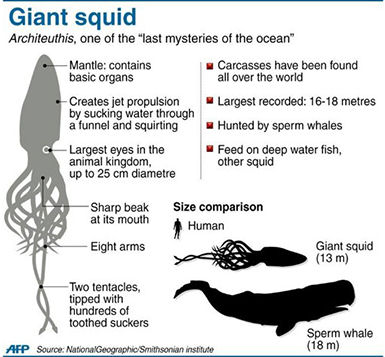
While giant squids have been captured in the past and alleged parts of them have surfaced here and there…seeing one in the wild has been something of a Holy Grail moment that misty-eyed scientists and cryptozoologists have dreamt about forever.
Everyone can prepare to drop your jaws because there is now video of one of these mysterious monsters going about its business deep in the Pacific Ocean.
A team of three Japanese scientists spent over 400 hours crammed in a 31 foot submersible over the course of 100 missions about 150 miles north of Iwo Jima.
At a depth of 2,066 feet, the lights from the submersible reflected onto the creature’s silver skin as it eyeballed the sub curiously before it swam off.
The Discovery Channel’s new branch, Curiosity, is keeping the footage secret until the season finale later this month when they’ll unveil it to the world for the first time…
Up until then? A lot of “Release the Kraken!” headlines.
Christmas has come and gone. Statuses everywhere are lit up with the swag given by friends and family.
Someone’s aunt got them this. Someone’s brother got them that.
Big flippin’ deal.
Why?
Because a group of scientists have been given gifts from freakin’ dolphins since 1998!
Dolphins!
Dolphins that offer gifts to humans!
Though the dolphins at the Tangalooma Island Resort in Australia haven’t been dropping PS3s or brand new iPhones they have been presenting gifts of food to human recipients. Scientists that have been studying these particular dolphins on a regular basis and in frequent contact with them have received everything from eels to tuna to squid.
Animals sharing food is a rare occurrence and typically takes place when an animal can’t fend for itself so others of its own kind help out. Most of the time it’s more ”you rub my back and I’ll rub yours” kind of a thing where the animal doing the giving expects something it can’t get for itself in return.
When they start offering up empty coffee cups they’ve found floating in the surf for Starbuck’s gift cards, though? THAT’S about the time we should all start questioning our place in things.
There are a lot of animals that mimic human vocalization.
But when an animal you’d never expect to develop mimicry suddenly begins doing it? It’s a little disturbing. Imagine if your dog suddenly quit barking and just started asking for his dinner in a crude-sounding human voice? You’d understandably be a little freaked the hell out.
This is exactly what happened recently National Marine Mammal Foundation in California. NOC, a nine-year-old Beluga whale, suddenly began making strange sounds unlike anything his trainers had ever heard. At first, no one could tell that it was actually the whale making the bizarre noises. As days went by and the sounds were more frequent, the trainers realized it was NOC.
There have been reports of this kind of mimicry taking place amongst Beluga whales (who’re often called the ‘canaries of the sea’) but it’s never been recorded until now.
At one point one of the divers actually got out of the pool that NOC was in and asked the other trainers at the facility who told him to get out of the pool. We could only imagine the slack-jawing that took place when they realized that their own whale had just told them to get out of his pool.
Just think…we’ve been looking for signs of a robotic take-over or the zombie apocalypse while these adorable whales have just been swimming around…plotting.
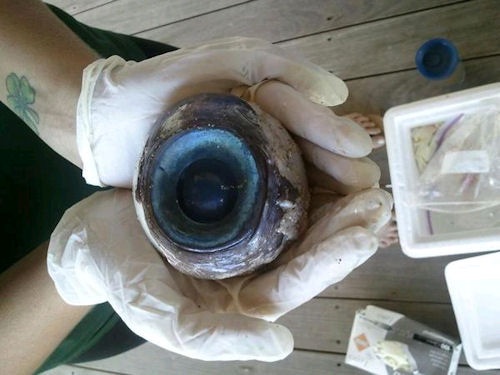
Some guy’s going for his morning stroll and spots something odd drifting around in the surf. Just like in any other horror film, the dude goes to investigate…and kicks it over…revealing at a huge eyeball staring right back at him.
“It was very fresh,” he said Thursday. “It was still bleeding when I put it in the plastic bag.”
Police referred him to the Florida Fish and Wildlife Conservation Commission who, frighteningly couldn’t identify what species the eye came from.
The Fish and Wildlife officers place the eyeball on ice and sent it to the Fish and Wildlife Research Institute for analysis.
In the end who really cares about where the eyeball came from…the Fish and Game Commission people should be looking for the thing that ripped apart the thing with the giant eyeball.
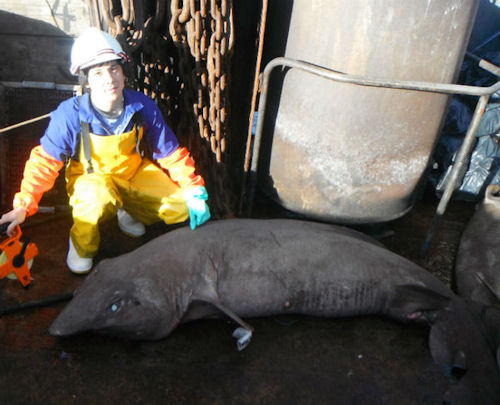
Paul Clerkin, a shark ecology graduate student at California’s Moss Landing Marine Laboratories, has been spending the last couple of months on a deep-sea trawling vessel in the Indian Ocean to see if the ship’s nets might pull up anything interesting in the way of sharks.
The trawler’s nets have been dropping to a depth of 6,500 feet off the coast of an island called Mauritius. What’s come up have been hundreds of strange-looking sharks. Several are species known to be very rare while others may be absolutely unseen before now.
“I tell people I have a ton of sharks, and they keep thinking I’m joking,” Clerkin said. “It was an actual ton. I brought back 350 sharks.”
What’s even cooler is that if any of the strange sharks are entirely new species? Clerkin gets to name them. He’s said that he’ll name a few after his mentors and possibly one after his mom and maybe himself.
NOAA, a government body that apparently has a lot of time on their hands, have recently laid to rest the idea that mermaids might actually exist.
According to NOAA? They don’t.
Thanks, NOAA…you’ve single-handedly just slapped several million little girls who adorably talk-sing ‘Part of Your World’ and dress up like Ariel right in their precious, red-wigged face and told them to “Knock it OFF!”
After a recent faux documentary called “Mermaids: The Body Found” aired on Animal Planet, NOAA decided it was time to put this silliness to rest once and for all.
“Mermaids: The Body Found” took small truths and sort of expanded upon them keeping the show just within the bounds of plausibility. Much like the “Alien Autopsy: Fact or Fiction” ‘documentary’ that aired on television in the 90s or going even further back to the original mayhem-causing broadcast of “War of the Worlds”, “The Body Found” sauntered up to the wall where science fiction and science fact eyeball one another and occasionally hi-five each other.
The mix of vague fact and more exciting fiction was just enough of a mix to get NOAA’s imagination police flustered enough to step in and settle this whole thing once and for all.
In a post titled “No Evidence of Aquatic Humanoids Has Ever Been Found,” NOAA states that:
The belief in mermaids may have arisen at the very dawn of our species. Magical female figures first appear in cave paintings in the late Paleolithic (Stone Age) period some 30,000 years ago, when modern humans gained dominion over the land and, presumably, began to sail the seas. Half-human creatures, called chimeras, also abound in mythology — in addition to mermaids, there were wise centaurs, wild satyrs, and frightful minotaurs, to name but a few. But are mermaids real? No evidence of aquatic humanoids has ever been found.
NOAA has also stepped up to swing a bat at the Lost City of Atlantis and the Bermuda Triangle.
New Zealand’s National Institute of Water and Atmospheric Research recently led an exploration of the Kermadec Ridge. Reaching depths of up to 4,100 feet and spanning 3,800 square miles that included everything from continental slopes and canyons to hydrothermal volcanic-vents.
Setting out to prove that, based on underwater terrain, undersea biological communities would be different, the expedition came back with not only new imagery of known species but new imagery of things not yet seen.
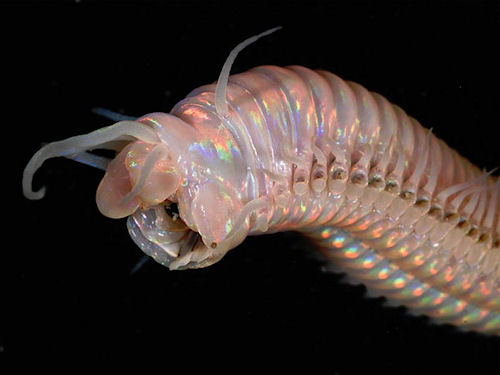
The polychaete worm pictured above is not only new but also a ferocious predator featuring a jaw set-up just like everyone’s favorite HR Giger-designed aliens.
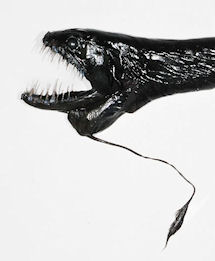
Other species include the demonic-looking Black Dragonfish and a very hairy-looking crab.
Oh…and I think someone snapped a pic of James Cameron waving as he drove by in his privately owned submersible…he’d already been there for weeks.
[National Geographic]
While it sounds like the last half of a Harry Potter book title, the Fire Urchin isn’t quite as fun.
Fire Urchins, which are found off the coast of Maui, Hawaii, get their name not from their typically blazing colorations but from the fantastically painful sting that comes from messing with one of these things. Not only are its red and white hair-like spikes venomous but at the base of each one of those tiny harpoons are small pincers containing even more poison just waiting to latch on to whatever prey wanders too close.
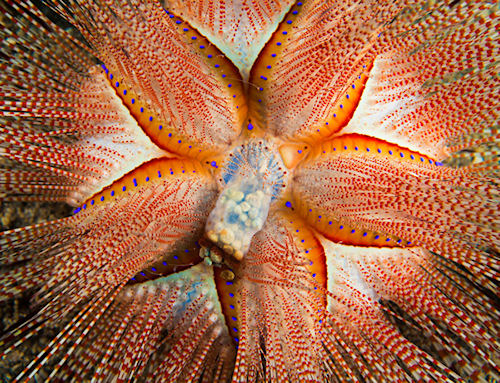
What’s fascinating about the above photo (looking directly down onto the urchin from above) and makes it really weird is that nature photographer David Fleetham caught, for the first time, one of these urchins in its final moments.
Looking at the center of the photo, you’ll see what looks like a bag of balls from a Chuck E. Cheese ball-pit…only not it’s quite as fun…
That sack is actually its entire insides being expelled through its mouth.
Single cell microbes in the most remote portions of the ocean floor dating back to days when dinosaurs roamed the Earth are indeed alive. But not by much.
Baaaaaaaaaaaaaaarely alive. Which is a scientific term. Each “a” signifying how much closer to complete nonexistence it is.
Røy and colleagues from Denmark and Germany surveyed red clays buried deep in the Pacific Ocean, along the equator and into the North Pacific Gyre current system. From the research R/V Knorr, they drilled core samples 92 feet into the ocean floor, dating to the time of the dinosaurs, and tested the cores with oxygen sensors. They found that organisms live in the deepest parts of these sediments and that they’re using oxygen for respiration — only incredibly slowly. The deeper the sediments, the less food and oxygen is present, and the less oxygen is used up, too. These organisms have not had access to a fresh food supply since their burial, 70 to 86 million years ago.
The finding could gives new insight into life on other planets. Now that we have an idea of just how durable life in on this particular rock we can have some hope that it could survive in a harsh environment elsewhere across the stars.
Shipwreck hunters have located an unusual object at the bottom of the Baltic Sea and will be heading out in May to find out what it really is.
Sonar readings show that the mysterious object is about 60 meters across, or, about the size of a jumbo jet. And it’s not alone. Nearby on the sea floor is another, smaller object with a similar shape. Even more fascinating, both objects have “drag marks” behind them on the sea floor, stretching back more than 400 feet.
“Could this be the Star Wars Millenium Falcon, a plug to an inner world or a marine version of Stonehenge?” asks CNN’s Brooke Bowman:
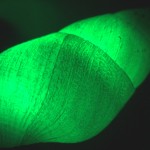
Located off the eastern coast of Australia, the clusterwink snail (Hinea brasiliana) uses a luminescent shell-flashing defense when its shell is tapped or when it detects predators nearby. Scientists think that this could either be a technique for attracting predators of the predator or perhaps a trick to scare them away. Recent experiments have shown that some crabs are frightened away by bioluminescent glowing creatures.
“When threatened, fingernail-sized H. brasiliana generates pulses of bioluminescent light from a single spot on its mushy body. The light pulses are variable, lasting as short as 1/50th of a second to as long as a few seconds. But the opaque shell diffuses only the blue-green color of light it generates — and no other color — like a highly selective frosted light bulb.”
According to our most recent studies, fears that we are the last generation to see coral reef due to the rising acidification of our waters is unfounded. This has been a fear raised by climate change studies which suggest CO2 concentration could jack up the pH balance of the seas and kill off marine life.
There is a whole ton of science on Matt Ridley’s awesome blog but here is the money shot:
In conclusion, claims of impending marine species extinctions driven by increases in the atmosphere’s CO2 concentration do not appear to be founded in empirical reality, based on the experimental findings we have analyzed above.
We are safe! Hooray!
No word on if we can just affect the pH balance enough to create monster fish or open a crack in an Arizona lake releasing thousands of blood-thirsty piranhas, in 3D.