Archive for the ‘Lake Monster’ Category

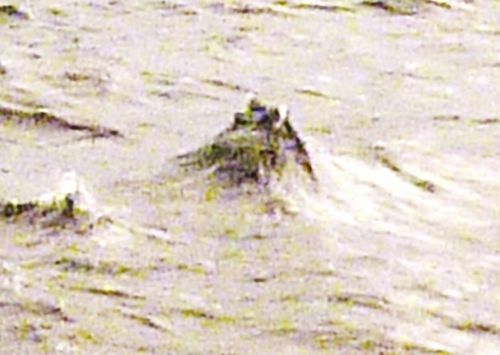
Proof? Man Gets Video Of Ogopogo Lake Monster

Tuesday, November 8th, 2011

The Canadian Loch Ness Monster equivalent Ogopogo is back in the news with this curious clip. A man on vacation gets the shot from an elevated perspective which seems to depict a large, if unmoving, object just underneath the gentle lapping water. But what could be that big and that still? Was Ogopogo playing hide and seek?

[MSNBC]

How To Operate A Lake Monster Hoax

Wednesday, June 30th, 2010

Each week, Weird Things’ own Matt Finley breaks down one of the oddest elements of our culture in a feature we call Monster Of The Week. This week we chronicle the Great Lake Monster Hoaxes. Monday we looked at the hoax that defined a town.

skitched-20100630-131941.jpgThe Lake George Monster never saved a town. It didn’t herald a tourism boom or lure swarms of industrialists to the shores of Hague Bay. It doesn’t funky chicken around the sidelines of any public school basketball courts. And Lake George isn’t known as “Home of the Lake George Monster,” but rather as “Gateway to the Adirondacks.” Credit where credit is due, though, the Lake George Monster is probably the most extreme point (short of boat murder) to which a friendly fishing contest has ever escalated.
In 1904, Harry Watrous, a professional painter, made a bet with his friend, Colonel William Mann, the editor of an infamous gossip rag, over who could reel in a larger trout. And so it began. The men fished on the lake, often in sight of each other, each one determined to fish better, harder, faster than the other. In retrospect, that Mann decided to cheat shouldn’t have come as a surprise.

The paper the Colonel edited, “Town Topics,” once a respectable arts and leisure magazine, had, under Mann, become an inky mire of high society gossip and scandal-mongering. Mann’s ploy to avoid libel charges? Print standard, sometimes even complimentary, articles about known New York society members on the front of a page, then, on the flip side, directly lined up with the corresponding fluff pieces, run scandalous news about the same individuals, sans identification. Anyone who knew how to read the paper – and anyone who was anyone did – could easily match the public figures to the defaming rumors. “Town Topics,” of course, stayed in business by collecting bribes from guilty parties who wished to keep their faux pas private. Still, when Watrous finally identified the hulking monster of a trout that Mann casually held up from inside his own fishing craft, and later, in a ridiculous display of bravado, exhibited in his house, as a sculpted and painted hunk of wood, he swore revenge.

Like the Rhinelander Hodag, the Lake George Monster began life as a chunk of wood (specifically, a cedar log). Using bits of glass, metal and wood, Watrous affixed eyes, ears and a toothy snout to the 10-foot-long log, which he then painted in alternating yellow and black stripes. Also, white teeth, red mouth, red nostrils, and blue (yes, blue) ears. (Later, Watrous would repeatedly refer to his creation as a “Hippogriff”- the mythical offspring of a griffin and a mare, and noble companion to the Boy Who Lived – but I’m not seeing it.) He rowed out to an area of the lake frequented by his friend and nemesis, and rigged up the creature to a simple pulley system – a 100-foot-rope anchored to a rock on the shore.

Then he waited.

MUCH MORE… AFTER THE JUMP

(more…)

Lake Monster Biting Indiana Children

Thursday, June 3rd, 2010

It’s lurking underneath the surface, waiting for little legs rubbery with summer excitement to come across it’s path. It’s the Hardy Lake Monster.

[CNN]

Omajinaakoos Identified As American Mink

Monday, May 24th, 2010

UglyOne.jpg

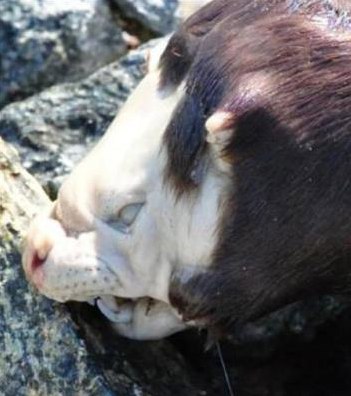
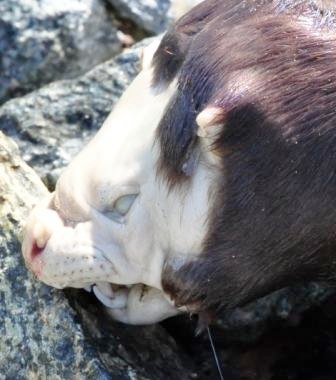
It looks like our Ugly One is really a decaying American Mink.

[Live Science]

Is “The Ugly One” An Evil Omen For Northern Canadian Community

Saturday, May 22nd, 2010

skitched-20100522-174330.jpg

A horrific looking animal has been discovered in a Northern Ontario lake. But some locals believe it can only bring bad news…

Some residents of Big Trout Lake, an Oji-Cree community of 1,200 south of Hudson Bay, believe the animal is a rare local creature known as an omajinaakoos, which roughly translates to “ugly one”. Band councillor Darryl Sainnawap said his great uncle spotted one about 50 years ago.

“He says in his younger days he was with his grandfather … and he did see this same creature and that’s the last time he saw it,” he said. “His grandfather called him omajinaakoos.”

Some local elders in the community, which is also known as Kitchenuhmaykoosib Inninuwug, believe the animal is a messenger of bad news.

“No one knows what it is but our ancestors used to call it the Ugly One. Rarely seen but when seen, it’s a bad omen. Something bad will happen according to our ancestors,” the community’s website says.

Mr. Sainnawap, 25, said the animal lives in swamps and feeds on beavers. Asked how the small critter could eat a beaver, he said: “That’s a good question. How could a wolverine take down a moose?”

Since the photos were posted on the community’s website, they have spread around the Internet, sparking intense speculation about the creature’s origins, ranging from the conceivable to the far-fetched.

Let us know your theories in the comments.

[Globe and Mail]

Why Russian Scientists Detonated A Bomb To Find A Patriotic Sea Dragon

Wednesday, March 17th, 2010

Spine-tingling action! Tear-jerking romance! Head-scratching pseudo-science! It’s the Weird Things Lake and River Monster Round-up – an occasional roll call of aquatic serpents that gives you, the reader, three lake monsters in three days. That’s almost two a day!

skitched-20100317-135751.jpg

Today: Russia’s Brosno Dragon

If I were the Brosno Dragon, I would be pissed. And not in the Stolichnaya-induced way.

In 2002, members of the Kosmopoisk research association (a large, paranormal-obsessed non-government brain trust) panty-raided Lake Brosno with echo sounding equipment and low-impact underwater explosives. If the conversation on the Kosmopoisk boat mimicked that of the Internet blogging community, dragon debunking theories – ranging from giant sturgeon to mutant beaver- clouded the cabin and deck while, beneath the water, the equipment’s hydroacoustic pulses tripped blindly over solid matter. After a time, the onboard computer indicated a strange, amorphous shape, about the size of a train car, skulking just above the floor of the 140-foot-deep lake. “That’s gotta be the most mutated beaver ever.” remarked one of the researchers as his crewmates deployed an explosive device intended to startle the mysterious blob into action.

This after all the Brosno Dragon did for its country.

skitched-20100317-140758.jpgIn the 13th century, when the Tatar-Mongol army fanned out across Asia and Eastern Europe, conquering the Russian army and dividing the Kievan Rus’ principalities into vassal states of the Mongol horde, the city of Novgorod (now Kiev), capital of the Kievan Rus, was spared invasion. If you ask a historian (or Wikipedia, for that matter) why the fierce invaders from the east pulled a U-ey a mere 100 km from the urban hub, he or she will probably tell you that, having conquered every other major city in the region, the Mongol commanders simply didn’t want to bother trudging through the area’s outlying squishity marshity swamplands. Ask a local, and you might hear a different story:

On the way to Novgorol, big cheese Mongol Batu Khan ordered his troops to take a rest along the shores of Lake Brosno. While the soldiers massaged each other’s feet and sang songs about blood, their thirsty horses moseyed down to the water’s edge. Suddenly, the Brosno Dragon burst from the lake, his razor teeth glinting like a soon-to-be-conceived baby’s father’s eye. The dragon fed. Horses, men, armor and weapons all cowed to the creature’s monstrous deglutition, the men’s shrieks and the horses’ whinnying screams all turned to horrid gargles by the torrents of foul mucous and hot spit that forced them over the drooling cataract of the beast’s yawning gullet. As the dragon gulped down flank after flank of the Mongolian army, Batu Khan hollered orders for an immediate retreat. The Mongols never attempted a second assault on Novgorol.

For the next few centuries, the Brosno Dragon napped and lazed and crapped out bridles and swords, rousing only for the occasional snack. For example: At one point, some Swiss mercenaries tried to bury some ill-gotten treasure on one of the lake’s small islands, until the dragon called “shenanigans” and devoured said island. (One modern theory suggests that surface disturbances attributed to the monster are actually caused by an underground volcanic vent. Just to play dragon’s advocate – you’d figure a giant creature whose diet consists of whole islands and live, armored horses would also create some significant bubbles in the tub, so to speak.) Otherwise, not much was seen of, or heard from, ol’ Brosny until WWII, when yet another invading army attempted to harsh Russia’s mellow. Always the national loyalist, the Brosno Dragon happily swallowed a Nazi airplane. (I wish this legend was a bit more fleshed out. It’s more fun, for example, to imagine the dragon leaping from the water to engulf a low-flying Luftwaffe craft than to picture him apathetically cherry-picking an already-disabled plane as it spiraled, smoking, out of the sky and into his slack-jawed mouth.)

On top of all that, there’s only one story that even suggests that the monster ever caused any Russian casualties, and in that tale, the dragon eats a single fisherman. And who knows? Guy was probably a wife beater.

2002 saw Russia sending a well-earned “Thanks, Dragon!”… In the form of low-impact, underwater explosives.

When the charge detonated, the researchers leered at the monitor, watching for any reaction from the giant, mystery lump at the lake’s bottom. Suddenly, movement! The shape on the screen began to drift toward the surface. The team scrambled to the side rails. I’ll let Vadim Chernobrav, Kosmopoisk coordinator, finish the story, as he told it to Russian newspaper “Argumenty i Facty”: “We starred at the water, and it was clear; there was nothing resembling a monster, however something unusual was still felt in the lake water.”

Perhaps that feeling was the vexed frustration of the last true Russian patriot, who Vadim Chernobrav’s team was lobbing bombs at it.

Or maybe the mutant beaver can exert psychical control over human emotions.

Friday: Utah’s Bear Lake Monster – the Mormon lake monster

Ogopogo! The Lake Monster That Demands Blood Sacrifice!

Monday, March 15th, 2010

Spine-tingling action! Tear-jerking romance! Head-scratching pseudo-science! It’s the Weird Things Lake and River Monster Round-up – an occasional roll call of aquatic serpents that gives you, the reader, three lake monsters in three days. That’s almost two a day!

Today: Ogopogo – British Columbia’s Okanagan Lake Monster

Nessie, Champ and Normie are all well and good in that 20th century third-hand account, blurry Polaroid sort of way. Ogopogo, though – Ogopogo demanded animal sacrifices from anyone wishing to cross over its lake. The Ogopogo of today seems a gentle giant, keeping to itself, and surfacing only for oblivious tourists and hopelessly unskilled videographers. But there was a time when the camera shy beastie trolled Okanagan’s waters with a ruthless vigilance and a bridge troll’s business acumen.

Aboriginal Salish people called the monster N’ha-a-itk, which supposedly means “lake demon” (lake demons – research that before you start thinking tribal tattoo). In the 1800s when the Europeans came barreling into the area, land-claim flags all a-thrust, it was these Aboriginals who warned the settlers about N’ha-a-itk’s strict lake toll, its supposed lair on the already-unenticing Rattlesnake Island, and its hunting grounds at Squally Point, where the Salish feared to fish. The Europeans took the news in stride, assigning armed guards to nightly lakeside patrols (not a bad idea any way, seeing as how they’d just, you know, stolen a bunch of land) and ensuring that the demon got his nummy blood tribute. It was these settlers who offered the first physical documentation of the monster – an engraving of the creature printed in the “Canadian Illustrated News” on November 30, 1872. That’s more than 60 years before the first recorded Nessie encounter.

With a paper trail of hearsay and sightings spanning back that far, one might think that Ogopogo would be eligible for a better name. N’ha-a-itk is as authentic as it is unmemorable, and other erstwhile monikers, like Snake-in-the-Lake and Wicked One, seem to serve the monster-wary namers more than the fearsome, aquatic named. But still – Ogopogo?! According to Mary Moon, author of “Ogopogo: the Okanagan Mystery” (1977), this amateurish palindrome that’s, depending on who you ask, a racist send-up skitched-20100315-154735.jpgof aboriginal dialect or a wacky homage to the just-introduced Pogo Stick, was supposedly coined by Bill Brimblecomb, “Weird Al” Yankovic’s Canadian predecessor. In a 1924 parody of a popular British Music Hall song, “Barmy Bill” Brimblecomb sang:

I’m looking for the Ogopogo,
His mother was a mutton,
His father was a whale.
I’m going to put a little bit of salt on his tail

Two years later, 30 carloads of beachgoers watched the monster surface into the open air and then dive back down into the depths of Okanagan. In the wake of the mass sighting, “Vancouver Sun” editor Roy Brown penned an article that more or less championed the existence of the beast, and the local Board of Trade met to decide on the animal’s Official Name. Guess what they chose.

Over the decades, more than 200 sightings of Ogopogo have been reported. Proponents of the legend enjoy pointing out that most witnesses describe the creature similarly – 15-20 feet long with a horse-like head. Many accounts also liken the creature’s appearance to that of a floating log. If it looks like a log and floats like a log, it’s probably a surviving Basilosauraus. Or so concludes British cryptozoologist Roy Mackal, who, in his book “Searching for Hidden Animals,” claims that Ogopogo resembles this prehistoric snake-like whale to a T.

The Jim Henson Creature Workshop had a different take on the Snake-in-the-Lake’s appearance. When asked to design puppets and CG models of the creature for the Lake Okanagan-set (New Zealand-filmed) family adventure movie “Mee-Shee: the Water Giant,” they decided to model Ogopogo after Walter Matthau. Had he been alive to see it, I’m sure Matthau would have been honored: “Ogo – Wha? I’m a muppet now? I thought I was already those other two muppets in the balcony. Ugh. Just make sure they pay my blood tribute.”

Wednesday: Russia’s Mongol-terrorizing, Nazi-eating Brosno Dragon