The Monolith of Mars
Friday, April 13th, 2012

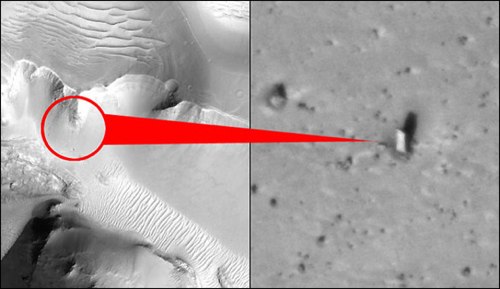
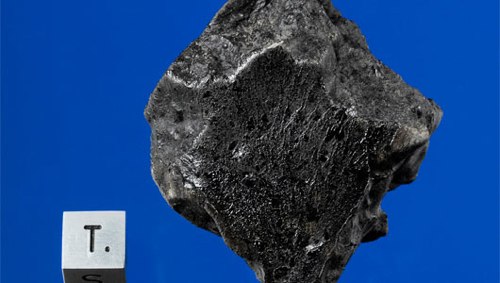
Is this a 2001: A Space Odyssey style monolith plopped on the surface of Mars? Kind of. Maybe. Not really. But it still looks awesome.
[Yahoo]

Is this a 2001: A Space Odyssey style monolith plopped on the surface of Mars? Kind of. Maybe. Not really. But it still looks awesome.
[Yahoo]

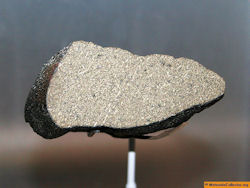
Pieces of Mars (thankfully not Drops of Jupiter) crashed to Earth last year in Morocco. Pieces of the rock are trading for $8,500 per ounce at minimum and $28,350 at max.
To keep that in perspective, Gold is currently trading at $1,650.
The high prices comes because their is so precious little of the substance on Earth at all. In fact, since we’ve known how to look for and identify Martian rock, only 220 lbs. have been found. What’s more, the stuff that crashed last year accounts for 24 lbs. of that.
“It’s pristine material,” (Darryl Pitt, curator of the Macovich Collection of meteorites in New York City) said. “Five hundred dollars and $600 a gram for a freshly fallen chunk of the planet Mars? I’d say that’s a deal.”
Forget a Gold Standard, I want Martian Standard.

And so was birthed, the Mars-er.
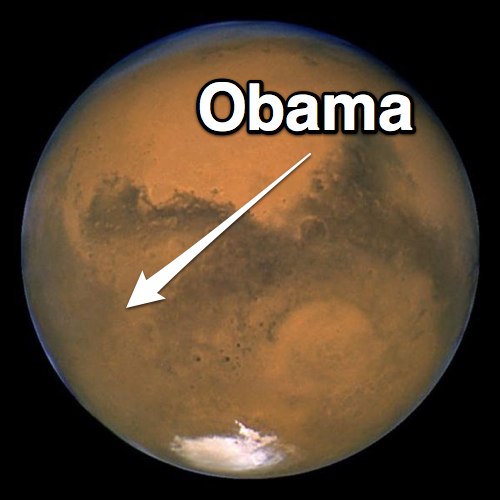
In a shocking new revelation surely set to explode into the national conversation as our 2012 election draws closer, a man has claimed that a 19-year-old Barack Obama teleported to Mars twice as part of a top secret government program.
Mr. Stillings’ statement, released at the same time, read: “I can confirm that Andrew D. Basiago and Barack Obama (then using the name “Barry Soetoro”) were in my Mars training course in Summer 1980 and that during the time period 1981 to 1983, I encountered Andy, Courtney M. Hunt of the CIA, and other Americans on the surface of Mars after reaching Mars via the “jump room” in El Segundo, California.”
The claims have been made by Andrew D. Basiago, a lawyer in Washington state who claims to have also been beamed to Mars twice. Among the unit of four college students he trained with was Obama’s appointed DARPA chief Regina Dugan.
Together, they were called Project Pegasus.
Responding to comment by Wired’s Danger Room blog a White House spokesman denied the story.
Officially, the White House says Obama never went to Mars. “Only if you count watching Marvin the Martian,” Tommy Vietor, the spokesman for the National Security Council, tells Danger Room. But that’s exactly what a secret chrononaut wants you to believe.
To be fair to the White House, Basiago claims that the CIA did their best to erase the memories of the expeditions from the minds of Project Pegasus’ participants. They might have done a better job with our future 44th president.
[Exopolitics via Danger Room]
You have until June 13th to submit your name to NASA’s Jet Propulsion Laboratory to be included on a microchip in the Mars Science Laboratory rover which is headed to Mars later this year. To date 1,171,344 names have been submitted and California, Texas, and Florida are dominating the U.S. participation.
[JPL]
So, yeah. 71 49 19.73n 29 33 06.53w in Google Mars if you want to see it yourself. What do you think it is?
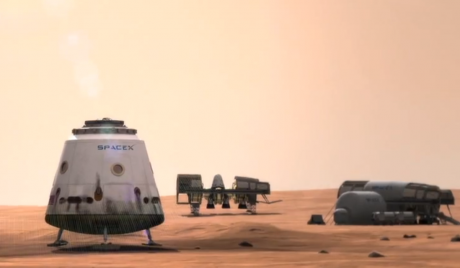
Space X released a video today showing their plans and capabilities for their Dragon space capsule. Besides the ability to ferry crew to and from orbit and to the International Space Station, Elon Musk, head of Space X has said that the capsule itself would be capable of using its built-in rockets to land on any solid planet, moon or asteroid in the Solar System. He described the heat shielding as being rated for “Martian and lunar” velocities.

Landing is one thing. What about a return trip, some have asked? If you look closely at the video Space X released you can get some idea of what they may have planned for a trip to Mars.
In the screen grab you can see the Dragon crew capsule in the foreground. In back of it looks like a crew habitat made from the stage of a rocket. Further in back you can see a platform with what looks like an ascent vehicle perched upright. This solves the ascent question.

Space X has talked publicly and informally about its plans for the future of space exploration. Besides the forthcoming Falcon 9 Heavy lift rocket, that would be the most powerful rocket since the Saturn V, they’ve also talked about a Falcon X Heavy and Falcon XX vehicles with 250,000 pounds of cargo capacity.
From the video it looks like we can see three of the four components you would need for a Mars round trip. The Dragon capsule as a lander for the astronauts. The crew habitat visible in the background and the ascent vehicle on a platform further out. Not shown is the space vehicle that would be used to bring astronauts from Earth orbit to Martian orbit.
If you look at Space X’s plans for future rocket engine technology, there are plans for motors that would be more than capable of the return trip. The one thing we haven’t seen is what their plans are for the spacecraft itself. It’d be curious to see what Elon Musk and Space X think this would look like. Let’s hop for more videos.
Elon Musk’s Space X promised a big announcement today and it was the unveiling of the Falcon Heavy. The short list of features: it can put 100,000 – 120,000 lbs. in orbit, has the thrust capacity of 15 Boeing 747s combined, is 30% the cost of previous rockets of this size, meets NASA requirements for human transport, can do the a trip to the ISS, moon or Mars(!!!) and back AND is ready to launch by the end of 2012.
Musk:
“Falcon Heavy would be capable of launching people as soon as we’ve proven it out with a few launches,” Musk said. “It opens up a wide range of possibilities, such as a mission to the moon or conceivably even Mars,” he said.
“First launch from our Cape Canaveral launch complex is planned for late 2013 or 2014,” Musk said.
M-A-R-S. Mars.
[Fox News]
If one day, in a shiny future filled with hope and promise science and engineering finally succeeds in putting the feet of a human on Mars, we could just be returning home.
That is the theory of one MIT research team which aims to forensically test elements of the Martian ground to see if Earth humans were descended from the same genetic origin.
The MIT team led by Christopher Carr and Maria Zuber (head of MIT’s Department of Earth, Atmospheric and Planetary Sciences) and Gary Ruvkun, a molecular biologist at the Massachusetts General Hospital and Harvard University, are proposing to build an instrument to send to Mars and test for extraterrestrial genomes.
Despite the numerous landers and rovers we’ve sent already, the only surface biology experiments were carried out in a bold but premature effort in 1976 aboard the trailblazing NASA Viking landers. The confusing results from these tests remain controversial and ambiguous today.
Even if we aren’t cosmic cousins with whatever critters skittered around The Red Planet once upon a time, the study has another benefit. It could greatly increase our understanding of microbes on Mars and if they would be hazardous to human settlers.
Because if they are, we might have to tent the planet for fumigation before moving in.
Mars is the bomb. Or rather, may have been bombed. But not by rogue Martians or those weenusmunchers from Venus. No, it was totally natural. This explosion wiped out all life on the planet and left it a wasteland of red sand. At least, according to one theory:
“The Martian surface is covered with a thin layer of radioactive substances including uranium, thorium and radioactive potassium — and this pattern radiates from a hot spot [on Mars],” Brandenburg told FoxNews.com.
“A nuclear explosion could have sent debris all around the planet,” he said. “Maps of gamma rays on Mars show a big red spot that seems like a radiating debris pattern … on the opposite side of the planet there is another red spot.”
According to Brandenburg, the natural explosion, the equivalent of 1 million one-megaton hydrogen bombs, occurred in the northern Mare Acidalium region of Mars where there is a heavy concentration of radioactivity.
Some are intrigued by the theory but others believe the only way to prove it would be to send a mission to Mars, which are resources better spent elsewhere, like trying to find other intelligent life.
Or we could just invent a time machine and hit it with a nuclear warhead. Problem solved.
[Fox News]

Well… duh.
Other theories (notably less awesome than an all powerful, semi-emo superman) include an “oblique impact, when a small body struck the surface at a very shallow angle.”
Boring.
[Pop Sci]
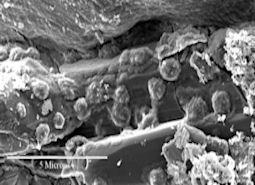
In 1996 a team of NASA scientists published a study saying the they’d found signs of life on a Martian meteorite that crashed to Earth in 1984. They were summarily dismissed by many.
14 years later, as science has caught up, their findings don’t seem so far fetched.
Could we have proof of life on the Red Planet right here?
[Pop Sci]
I believe that children are the future, give them pictures of Mars and let them find the caves.
A heretofore unidentified Martian cave opening was found by a group of 7th graders. It was completely unrecorded by our official geological survey of the Red Planet.
the students examined more than 200 images of Mars taken with the Thermal Emission Imaging System (Themis), an instrument on NASA’s Mars Odyssey orbiter.
Using that camera, the students focused on the area around the planet’s Pavonis Mons volcano. The only other similar opening near the volcano was found in 2007, when Glen Cushing, a scientist with the U.S. Geological Survey, published a research paper on the surface anomalies.
“This pit is certainly new to us,” Cushing told the students, according to a release from the university. He estimated the opening to be 620 feet by 520 feet and the hole to be at least 380 feet deep.
Yeah… but let’s see them buy a pack of cigarettes!
[CNET]
If you had “strange but undeniable resulting pattern caused by a million years of whipping from Martian wind” in the What With The Bizarre Shape Of The Mars Ice Cap pool, please collect your winnings.
According to a new NASA study, the deep grooves in the ice cap, once considered to be proof of a horrific volcanic eruption which left chasms that could easily hold the Grand Canyon, now look the the results of eons of work done by natural forces.
It points to an ancient process, over millions of years, by which the ice and dust accreted while at they same time were sculpted by a powerful, persistent force: the Martian wind.
“Nobody realised that there would be such complex structures in the layers,” Holt said.
“The layers record a history of ice accumulation, erosion and wind transport. From that we can recover a history of climate that’s much more detailed than anybody expected.”
So, there we go.
[AFP]
We are proud to introduce our new YouTube series, WeirdThingsTV. If you dig this, please feel free to subscribe on YouTube so you don’t miss an episode.
Next clips will come out Monday, Wednesday and Friday.
There has long been a school of thought that bacteria from Earth could contaminate possible life on Mars should be take a man made trip to the Red Planet. However, a new study out of the University of Central Florida says no matter how many smallpox blankets we bring, it is unlikely to make a difference.
Ultimately it is unlikely such microorganisms will be able to replicate once on the Martian surface, the research suggests.
“Without replication, terrestrial microorganisms are very unlikely to contaminate a landing site,” Andrew Schuerger, one of the study’s researchers, told SPACE.com. “Thus, it is unlikely that spacecraft microbes will compromise the search for organics or the search for life on Mars.”
Mars has been one of the primary places that scientists have expanded their quest for extraterrestrial life, and while Curiosity is not intended to be a life-seeking mission, it is still important for a rover to have minimal bacterial impact on the red planet.
Screw it, the first man on Mars should be stained with BBQ sauce and sporting an unseemly running nose while wiping his hands with red rocks.