Archive for the ‘Marine Biology’ Category

Giant Squid Caught on Camera in the Wild For the First Time!

Tuesday, January 8th, 2013

Giant squids are legendary.

They’ve taken on Moby Dick, Captain Nemo’s Nautilus and even a bunch of Goonies.

While giant squids have been captured in the past and alleged parts of them have surfaced here and there…seeing one in the wild has been something of a Holy Grail moment that misty-eyed scientists and cryptozoologists have dreamt about forever.

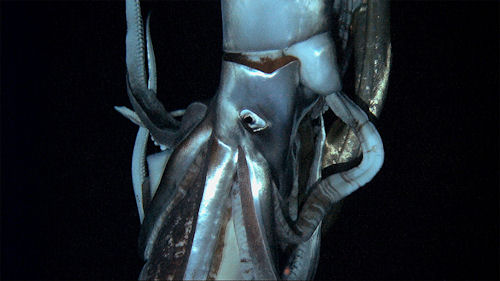
Everyone can prepare to drop your jaws because there is now video of one of these mysterious monsters going about its business deep in the Pacific Ocean.

A team of three Japanese scientists spent over 400 hours crammed in a 31 foot submersible over the course of 100 missions about 150 miles north of Iwo Jima.

At a depth of 2,066 feet, the lights from the submersible reflected onto the creature’s silver skin as it eyeballed the sub curiously before it swam off.

The Discovery Channel’s new branch, Curiosity, is keeping the footage secret until the season finale later this month when they’ll unveil it to the world for the first time…

Up until then? A lot of “Release the Kraken!” headlines.

[Discovery.com]

Dolphins Decide Humans Are Alright – Share Their Food!

Saturday, December 29th, 2012

Christmas has come and gone. Statuses everywhere are lit up with the swag given by friends and family.

Someone’s aunt got them this. Someone’s brother got them that.

Big flippin’ deal.

Why?

Because a group of scientists have been given gifts from freakin’ dolphins since 1998!

Dolphins!

Dolphins that offer gifts to humans!

Though the dolphins at the Tangalooma Island Resort in Australia haven’t been dropping PS3s or brand new iPhones they have been presenting gifts of food to human recipients. Scientists that have been studying these particular dolphins on a regular basis and in frequent contact with them have received everything from eels to tuna to squid.

Animals sharing food is a rare occurrence and typically takes place when an animal can’t fend for itself so others of its own kind help out. Most of the time it’s more ”you rub my back and I’ll rub yours” kind of a thing where the animal doing the giving expects something it can’t get for itself in return.

When they start offering up empty coffee cups they’ve found floating in the surf for Starbuck’s gift cards, though? THAT’S about the time we should all start questioning our place in things.

[Discovery.com]

Beluga Whale Speaks Crude Human!

Tuesday, October 23rd, 2012

There are a lot of animals that mimic human vocalization.

But when an animal you’d never expect to develop mimicry suddenly begins doing it? It’s a little disturbing. Imagine if your dog suddenly quit barking and just started asking for his dinner in a crude-sounding human voice? You’d understandably be a little freaked the hell out.

This is exactly what happened recently National Marine Mammal Foundation in California. NOC, a nine-year-old Beluga whale, suddenly began making strange sounds unlike anything his trainers had ever heard. At first, no one could tell that it was actually the whale making the bizarre noises. As days went by and the sounds were more frequent, the trainers realized it was NOC.

There have been reports of this kind of mimicry taking place amongst Beluga whales (who’re often called the ‘canaries of the sea’) but it’s never been recorded until now.

At one point one of the divers actually got out of the pool that NOC was in and asked the other trainers at the facility who told him to get out of the pool. We could only imagine the slack-jawing that took place when they realized that their own whale had just told them to get out of his pool.

Just think…we’ve been looking for signs of a robotic take-over or the zombie apocalypse while these adorable whales have just been swimming around…plotting.

[Exclusive TV News' YouTube]

Mysterious Ocean Crop Circles Perpetrator Discovered!

Monday, September 24th, 2012

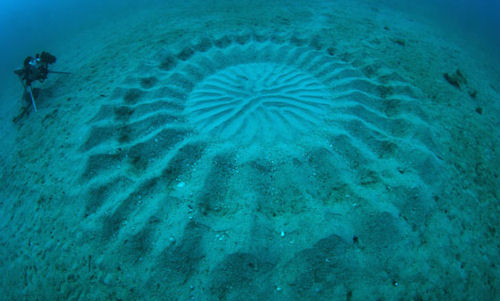
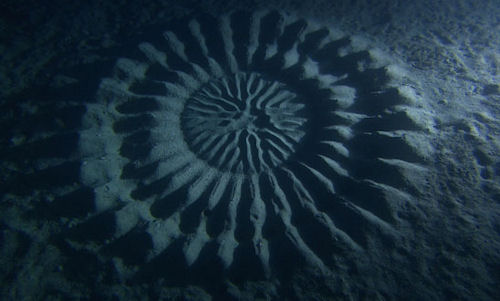
What you’re looking at isn’t the newest trend in ‘crop-circling’. The thing that created this spectacular-looking sand sculpture isn’t an alien trying to communicate with humankind, either.

The master craftsman behind this amazing looking design is something far less scary and almost kind of adorable.

Yoji Ookota, an office worker who left his cubicle life to pursue his love of underwater photography, recently discovered something that no one had seen until his camera caught sight of it.

A six-foot-wide, elaborate geometric shape 80 feet under the surface of the water on the sea floor. Then he began to spot more of them. Ookota dubbed them the ‘mystery circles’.

As Ookota began to study the circles to find out how they were created, he found the culprit.

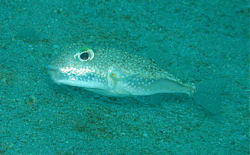
An adorable little male puffer fish.

In an amazing display of engineering and the need to be loved, the male puffer fish uses its fins and works day and night to create these things in order to attract females to mate with them. Once the puffer fish creates the ridges, males have even been seen filling their mouths with shells and blowing them onto the ridges they created like they were doing some primitive, animal form of bedazzling.

Females, attracted by the final design, join the male in the center of the design and mate. Later on the female returns to the center of the ‘mystery circle’ and lays her eggs.

These ‘mystery circles’ aren’t just for decoration either. Those shells used to ‘bedazzle’ the ridges appear to serve as nutrients to the young fish when they hatch. According to the most recent research, the design isn’t just for decoration and attracting a mate. The design also features a small bit of engineering. Scientists are discovering that the ridges also serve to protect the eggs from predators and currents that could scatter the eggs across the ocean floor.

This fish has more motivation and interior design abilities than most guys we know.

Weirdly amazing.

[Spoon & Tamago]

Deep Sea Trawler Pulls Up Weird, New Sharks!

Wednesday, August 15th, 2012

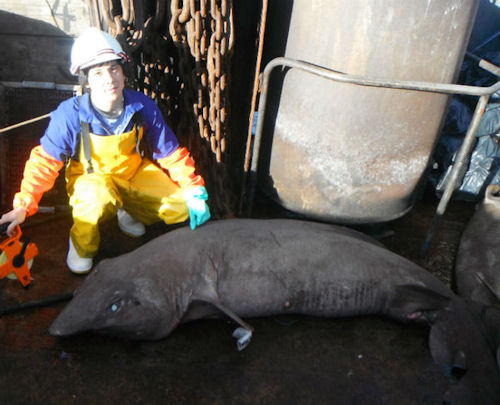
Paul Clerkin, a shark ecology graduate student at California’s Moss Landing Marine Laboratories, has been spending the last couple of months on a deep-sea trawling vessel in the Indian Ocean to see if the ship’s nets might pull up anything interesting in the way of sharks.

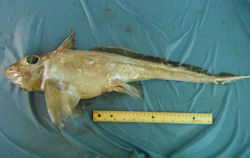
The trawler’s nets have been dropping to a depth of 6,500 feet off the coast of an island called Mauritius. What’s come up have been hundreds of strange-looking sharks. Several are species known to be very rare while others may be absolutely unseen before now.

“I tell people I have a ton of sharks, and they keep thinking I’m joking,” Clerkin said. “It was an actual ton. I brought back 350 sharks.”

What’s even cooler is that if any of the strange sharks are entirely new species? Clerkin gets to name them. He’s said that he’ll name a few after his mentors and possibly one after his mom and maybe himself.

We can hear his intro now…”I’m Paul Clerkin. You may not know me. A species of shark bears my name.”
Awesome.
[See a photo gallery of these weird sharks via OurAmazingPlanet.Com]
[MSNBC]

Australian Dolphins Are Teaching Each Other How To Use Tools To Catch Fish

Tuesday, August 30th, 2011

In an effort to be accepted by their peers, dolphins located in Western Australia’s Shark Bay have been spotted “conching.” What is conching? Conching is a method used to catch fish by trapping them in a conch shell, bringing that shell to the surface and shaking that shell with your beak inside the conch so that the fish falls into your mouth.  The curious part of conching is that this appears to be a learned behavior that other dolphins are observing and mimicking.  Early conchers were doing this as early as 2007 but in the last four months there have been as many as seven documented conching instances.  There is still much speculation as to the actual technique used underwater as scientists have only been able to observe “conching” from the surface.

“That’s significant on a few levels. For one, we already know dolphins are very intelligent creatures, but a horizontal spread of a learned behavior at this rate is pretty off-the-charts. Moreover, scientists appear to have gotten in on this fad at the ground floor (they were observing dolphins conching way before it was mainstream, bro), so they have the opportunity to observe this learned behavior as it spreads.”

[Popular Science]

Podcast: Destroyer of Worlds

Tuesday, June 29th, 2010

weird things podcast SM

Find out which of the three used to wear a Spider-Man costume under his clothes and which ones just wore ladies underwear. Listen to them describe their plans to capture a sea beast, fight alligators and find proof of Son of Hogzilla. Also, it becomes painfully obvious that when Justin, Brian and Andrew are a dying alien civilization’s last chance for survival, it’s better to die screaming in the night then hope to see another tomorrow.

Subscribe to the Weird Things podcast on iTunes
Podcast RSS feed
Episode archive
Download url: http://itricks.com/upload/WeirdThings062910.mp3

Listen now


Wanna Buy A FeeJee Mermaid?

Saturday, October 17th, 2009
http___cgi.ebay.com_ws_eBayISAPI.dll?VISuperSize&item=130337335350-1.jpg

You know what would brighten up your life? Your own PT Barnum style FeeJee Mermaid!

This lovely lass is on sale via eBay with the bidding beginning at the low price of $399.99. After all, we are into the holiday season…

Thanks to Weird Thing reader Adam for the tip.

The Mermaid Legend Has Died! Long Live The Mermaid Legend!

Friday, October 2nd, 2009

Mermaids are the Monster of the Week! Monday, Matt Finley investigated the evolution of the bang-able mermaid. Tuesday, he looked at the Mermaids history as a sideshow attraction. Enjoy!

skitched-20091002-142225.jpgSometime during the 1800s, after centuries of alternately fascinating, discomforting and titillating seamen and civilians, mermaids disappeared from the oceans, a loss for which the advancement of oceanographic science and the advent of international industrial and commercial air travel share culpability. Coincidentally, modern aviation also provides a minor, but fascinating, link to mermaid folklore in the 20th century.

(There was a rash of mermaid sightings off the coast of Israel in August of this year, when residents claim to have repeatedly witnessed a half-human, half-fish creature frolicking in coastal waters. These encounters, however, seem less relevant to a focused discussion of mermaids than to a broader analysis of how regional socio-political upheaval can yield increased cryptid sightings. See Tanzania’s Popobawa for the starkest example of this phenomenon.)

As addressed in Monday’s post, the earliest mermaid sightings, outside of mythological iconography, were reported during nautical expediti

buy cialis online

ons, and circulated among sailors, most of whom were, by stated allegiance or signed contract, government employees. During the first half of the 20th century, there weren’t many historically relevant appearances of merfolk, but two that do exist directly correlate to the creature’s original background in the fevered imaginings of haggard nationalists flung across latitudes in the name of their countries. In WWI, Warsaw, Poland, used the image of a mermaid, part of their traditional city seal, on medals of valor awarded to homecoming soldiers. During WWII, cartoon mermaids – lips puckered and ample bosoms straining against oyster-shell brassieres – were included in the spate of cheesecake pinup icons adorning U.S. fighter plane fuselages. The mermaids sighted so long ago in strange waters surrounding unmapped continents informed a continued linkage between the image of these mythological temptresses and the indefatigable will of a nation to assert itself beyond its physical boundaries, whether through exploration or warfare.

By turning innovation and engineering skyward, aviation lent the ocean a less-triumphant-than-antsy “veni, vidi vici” quality. It isn’t surprising, then, that as mermaid sightings tapered and died, 1877 brought the first recorded encounter with a flying humanoid, reports of which have increased in number over the last 135 years. Such is the joyful blind redundancy of folklore, guaranteeing myriad new cryptids that people will someday hatch from wild half glimpses stolen in the buzzing blue forks of light between telepods and the thin, shadowed creases of wormholes.

zp8497586rq

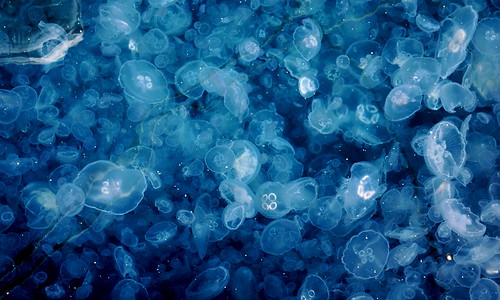
Immortal Jellyfish are taking over the ocean!

Saturday, April 4th, 2009

Turritopsis Nutricula, a species of jellyfish native to the Caribbean, has now spread to all corners of the ocean. Why? Because they don’t die:

Turritopsis Nutricula is technically known as a hydrozoan and is the only known animal that is capable of reverting completely to its younger self.

It does this through the cell development process of transdifferentiation.

Scientists believe the cycle can repeat indefinitely, rendering it potentially immortal.

This according to a Telegraph article about the interminable little critters.

Amazingly these jellies can reach sexual maturity, revert to a polyp state, then grow to sexual maturity again ad infinitum. But don’t flee the oceans just yet. The little fellas are only five millimeters long and are harmless….for now.