In the first of a two part episode we’re introduced to the macho cop alter egos of Brian and Justin. Brian eats up NASA’s arsenic announcement despite Andrew and Justin telling him why he shouldn’t. Then we all learn a valuable holiday lesson when Brian touches someone’s package and nearly dies.
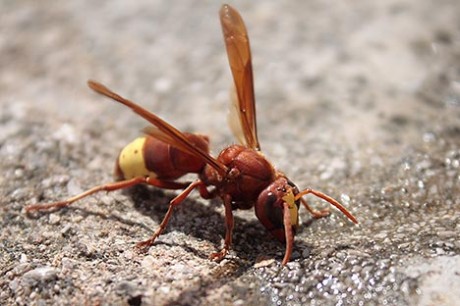
Scientists have recently discovered that the exoskeleton of the oriental hornet (Vespa orientalis) contains special structures that trap sunlight and convert it to energy. Using an atomic force microscope they discovered that the yellow band on the abdomen was structurally different than the rest of their body.
This is made from a series of oval-shaped protrusions, each containing a pinhole-sized depression. Each protrusion is just 50nm tall and interlocks with another…Essentially, say the researchers, they stop light being reflected off the hornet’s body. Instead the light is trapped, and harvested for energy.
The Croatian Astronomical Society Vidulini is planning on putting a rover on the moon by the end of 2012 near where Apollo 17 last landed in 1972. The rover is called Histrohod and will only cost 20,000 Euros to build. The Astronomical Society Vidulini created the first Croatian space program (Astronautika) and is also part of team “Synergy Moon” which is participating in the Google Lunar X Prize contest.
Through a group of mobile devices, “Histrohod” will send televised segments down to Earth. This is a big challenge for our society and we are extremely proud that our association and our small Istria will become a part of space exploration,” said the Society’s president Marino Rumpic
Hunters in the remote woodlands of the Sichuan province in China caught a small hairless creatures that is said to resemble a bear with a kangaroo tail. The creature has been shipped to Beijing for scientists to examine and DNA test. The creature has been named the “Oriental Yeti” because the hunters believe the creature is a legendary animal that was once human.
“There are local legends of a bear that used to be a man and some people think that’s what we caught,” said hunter Lu Chin.
While local legends are well and good, everybody knows that if you find a hairless, mangy creature of any kind, the answer is chupacabra. This is a bold new direction for hairless animal discoveries that will resonate around the world.
A species of assassin bug, Stenolemus bituberus, sneaks onto spiders’ webs and pretends to be prey, then captures and eats the spider when it comes to investigate. It was noted that on occasion the ploy of the assassin bug failed and it ended up being a meal for the spider regardless.
“The assassin bug slowly approaches the spider on its web, using its forelegs to pluck the silk threads in a manner that simulates the vibrations of a fly struggling after being caught. Wignall studied the behavior of the bugs, and found that the response of the spider to the predator was the same as its response to when a vinegar fly or aphid was caught in the web.”
That cute little star that you’ve pointed out to your son/daughter/neice/ward you’re training to fight crime? It could be an insanely badass wormhole big enough to fit a human or spaceship.
So the next time you’re telling the story of the sky make sure not to skip the part where we could all be sucked in a sweet wormhole and battle beings from another dimension. And stuff.
Wikileaks founder Julian Assange spoke with The Guardian including this awesome tidbit:
Many weirdos email us about UFOs or how they discovered that they were the anti-christ whilst talking with their ex-wife at a garden party over a pot-plant. However, as yet they have not satisfied two of our publishing rules.
1) that the documents not be self-authored;
2) that they be original.
However, it is worth noting that in yet-to-be-published parts of the cablegate archive there are indeed references to UFOs.
So causing an international kerfuffle revealing covert forces for freedom and democracy in the regions most in need of it, putting in danger deep cover assets and confirming Moammar Gadhafi as a cold pimp is totally within bounds, but UFO cable is a little too dicey to reveal?
Brian and Justin gleefully seek to tear down a forest in favor of a superhighway despite the locals pleas to protect a dangerous secret. Andrew makes everyone nervous with his delight over a new weapon.
This news report on a Jamaican Ghost was sent to us today. Our question to you the reader, was this set up from the start or did the news crew genuinely stumble upon an afflicted family? Thanks to Nathan for sending this in.
Researchers from the Multisensory Perception and Action Group at the Max Planck Institute for Biological Cybernetics in Tübingen, Germany have provided evidence that if you ever become lost in the desert you are more than likely going to cross your own path. Using GPS tracking, the scientists dropped people off in the Sahara and forests in Germany and monitored their movements. As long as the subjects had visible cues as to their direction from the sun or the moon, they managed to walk a relatively straight line. However, as soon as they had no indicators, they immediately started walking in circles.
“The results from these experiments show that even though people may be convinced that they are walking in a straight line, their perception is not always reliable. Additional, more cognitive, strategies are necessary to really walk in a straight line. People need to use reliable cues for walking direction in their environment, for example a tower or mountain in the distance, or the position of the sun.”