Archive for the ‘Astronomy’ Category
Thursday, June 3rd, 2010
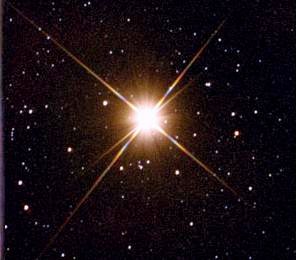
Phil Plait dissects a recent rumor about the Betelgeuse star. The short version of the rumor? The star is going to go all supernova in weeks or months (not years or hundreds of years) and the brightness could affect crops and cause streaming panic in the streets.
Phil’s rebuttal? Not so much.
That doesn’t mean you shouldn’t start stockpiling canned goods and telling your friends the sky is falling just so in two months when you pal’s newly orphaned children are huddled in your bunker to get away from the blood-thirsty mobs left by a post-apocalyptic society you can say… “I told your pa this was coming, (wistful glance to a bare wall) wish he would’ve listened.”
[Bad Astronomy]
Posted in Apocalypse, Astronomy | Comments Off on Is A Massive Star About To Collapse, Fry Us All?
Friday, May 7th, 2010
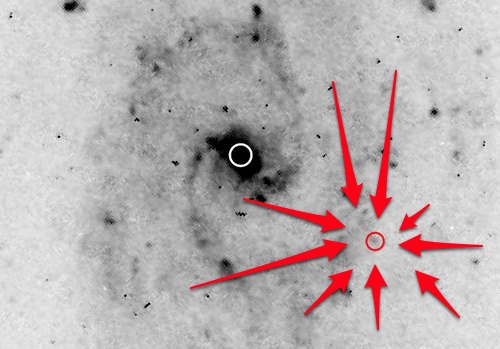
Probably not, but maybe!
A mystery object in a galaxy far, far away could be a supermassive black hole that got booted from its home galaxy’s center, according to a new study.
Then again, the strange body could be a rare type of supernova or an oddball “midsize” black hole—more massive than black holes born when single stars explode but “lighter” than the supermassive ones at the centers of galaxies.
“All three of those [options] are exotic and have something peculiar to them,” said study co-author Peter Jonker, an astronomer with the Netherlands Institute for Space Research in Utrecht.
Guess which option we’re rooting for? I’ll give you a hint, the site isn’t “Moderately Surprising Things.com”. I believe in the ejected!
Posted in Astronomy, Black Hole | Comments Off on Have Scientists Found First Ever Proof Of Ejected Black Hole?
Thursday, April 29th, 2010
A thin film of water ice and organic material has been identified on an asteroid by a NASA telescope. This bolsters the theory that an asteroid brought both crucial elements for life to Earth.
“It now appears that when the asteroids and planets were first forming in the very early Solar System, ice extended far into the Main Belt region,” said Josh Emery, a planetary scientist at the University of Tennessee in Knoxville. “Extending this refined view to planetary systems around other stars, the building blocks of life — water and organics — may be more common near each star’s habitable zone.”
The discovery also confuses the definition of comets and asteroids, in case you were wondering.
[Pop Sci]
Posted in Asteroid, Astronomy, Earth | 1 Comment »
Thursday, April 15th, 2010
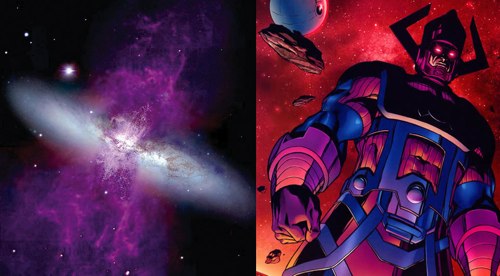
Who needs The Watcher? According to radio astronomers at the University of Manchester, a “baffling new object” in a nearby galaxy is unlike anything they’ve seen before.
But those who know better sure recognize that color scheme, that stature…
The object appeared very suddenly last May at radio wavelengths and has persisted ever since, showing no signs of going away. It was originally thought to be a young supernova, as M82 is a known star nursery. But most of M82’s stars die quickly in massive stellar explosions — a new supernova generally occurs once every two or three decades — at which point their radio wavelengths begin a slow decay. The mystery object has shown no such signs of dimming.
I for one welcome our new world eating overlord.
[PopSci]
Posted in Astronomy, Galactus | 2 Comments »
Wednesday, April 14th, 2010
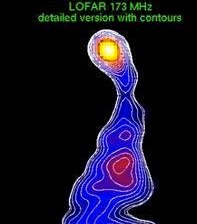
As per Popular Science:
Until recently, radio astronomers have concentrated almost exclusively on the high-energy radiation streaming in towards Earth from exotic stellar bodies like pulsars, quasars, and super-massive black holes. But now, a new European observatory called the Low Frequency Array (LOFAR) has begun releasing data on the low-energy radiation that permeates the Universe.
While seemingly less sexy than high-energy research, low-energy radiation actually allows scientists to look even deeper into the past, to within 500,000 years of the Big Bang, and will provide a much more detailed account of some of the most mysterious periods of the Universe’s earliest days of existence. LOFAR is also going to be used by SETI to search for faint signs of extraterrestrial life.
Heavy, Doc.
[PopSci]
Posted in Aliens, Astronomy, Big Bang | 1 Comment »
Monday, January 4th, 2010
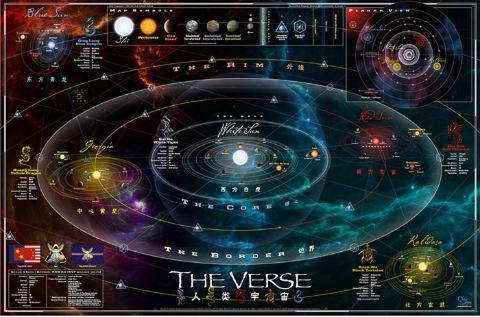 After the discovery of Neptune in 1846 astronomers began to wonder if there were other planets beyond its orbit. The discovery of Pluto (now not a planet) seemed to answer the question, but others wondered if even further out a larger earth-sized object could be waiting to be discovered.
Space.com has a fascinating claim made by a planetary scientist, Alan Stern at the Southwest Research Institute:
“When the solar system’s story is finally written, it’s much more likely that it will have closer to 900 planets rather than the nine that we grew up with.”
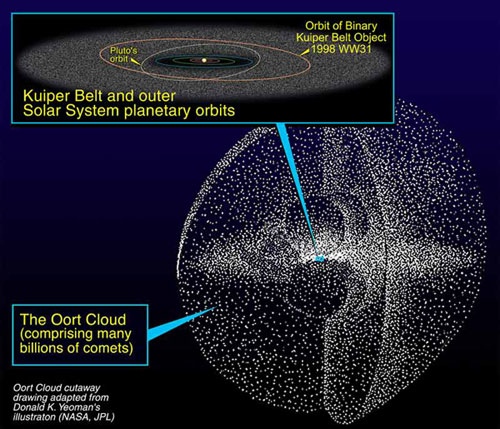
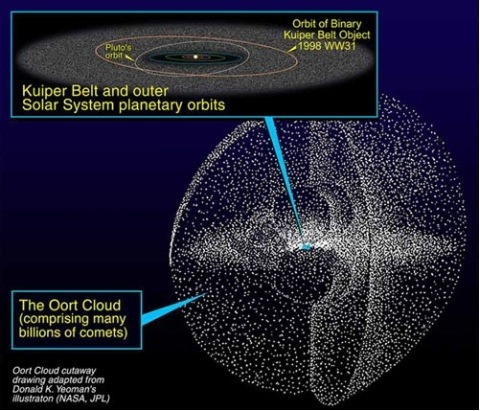
900 planets? How could that be possible? Anything Earth or Mars-sized in the Kuiper Belt beyond Neptune would be visible; but beyond the Kuiper Belt is the Oort Cloud:
Brown and Stern say that the Oort Cloud represents a more likely prospect for worlds the size of Mars or Earth. The Oort Cloud surrounds our solar system with billions of icy bodies at distances as far out as 50,000 times the distance between the sun and Earth.
 Now these planets are likely to be colder than Hoth, but who knows what we could do with some extreme terraforming…
link: Earth-Sized World Could Lurk in Outer Solar System – Yahoo! News
Posted in Astronomy, Space | Comments Off on Does Our Solar System Have 900 Planets?
Wednesday, December 16th, 2009
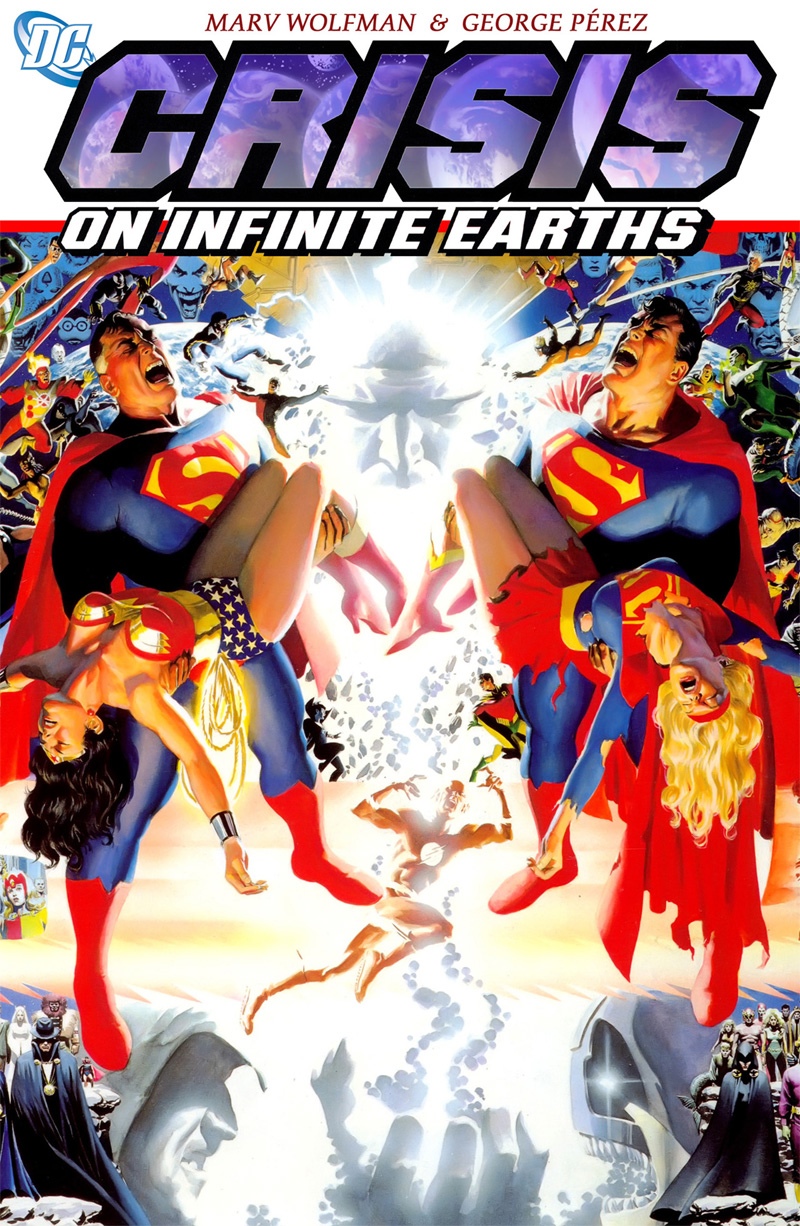
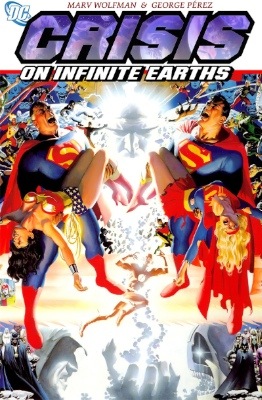 In the latest Scientific American theoretical physicists Alejandro Jenkins and Gilad Perez speculate that there might be a greater chance of life developing in other universes with different physical laws and that our own may not be as finely tuned as once thought.
Our recent studies, however, suggest that some of these other universes—assuming they exist—may not be so inhospitable after all. Remarkably, we have found examples of alternative values of the fundamental constants, and thus of alternative sets of physical laws, that might still lead to very interesting worlds and perhaps to life. The basic idea is to change one aspect of the laws of nature and then make compensatory changes to other aspects.
This runs counter to the idea that life in our universe is unique because the chances of the local laws of physics allowing for it are so rare.
For example, if life really is possible in a weakless universe, then why does our own universe have a weak force at all? In fact, particle physicists consider the weak force in our universe to be, in a sense, not weak enough. Its observed value seems unnaturally strong within the Standard Model. (The leading explanation for this mystery requires the existence of new particles and forces that physicists hope to discover at the newly opened Large Hadron Collider at CERN near Geneva.)
Posted in Astronomy, Science | Comments Off on A Crowded Multiverse?
Monday, November 2nd, 2009
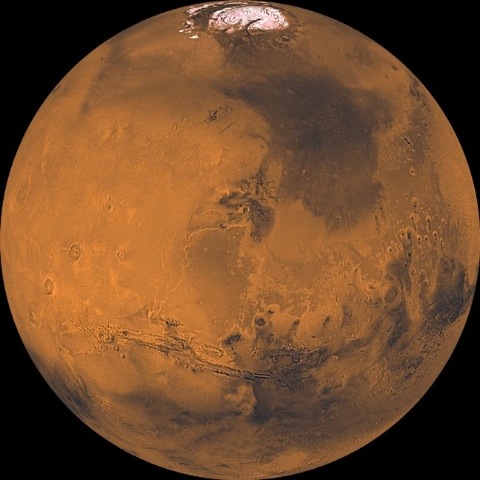 In an interesting experiment to see how well terrestrial bacteria might survive on Mars, a group built their own Mars simulator.
From UniverseToday.com:
A team led by Giuseppe Galletta of the Department of Astronomy at the University of Padova simulated the conditions present on Mars, and then introduced several strains of bacteria into the simulator to record their survival rate.
So how did the experiment turn out?
The results – some of the strains of bacteria were shown to survive up to 28 hours under these conditions, an amazing feat given that there is nowhere on the surface of the Earth where the temperatures get this low or the ultraviolet radiation is as strong as on Mars.
We can all discuss this at the upcoming Carl Sagan Day: Carl Sagan Day Saturday November 7th
Bacteria Could Survive in Martian Soil | Universe Today
Originally from Arxiv and here
Posted in Astronomy | Comments Off on Mars Needs Bacteria
Thursday, October 8th, 2009
The Russian space research institute IKI has announced ambitious plans to explore the planet Venus. Is this a sign that they’ve forgone Mars because the “Red Planet” is just so cliche now? Or do they know something we don’t?
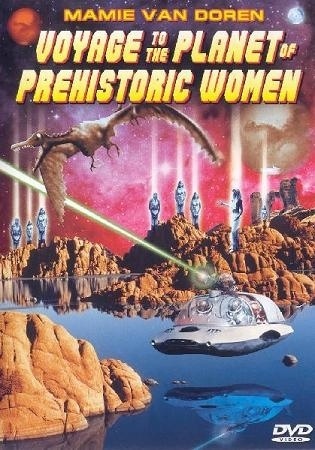
BBC NEWS | Science & Environment | Russia plots return to Venus
Posted in Astronomy | Comments Off on Ruskies plan to invade Venus
Wednesday, October 7th, 2009
Posted in Astronomy, Science, Space, Video, Weird Space | Comments Off on NASA to blow up the Moon
Tuesday, September 8th, 2009
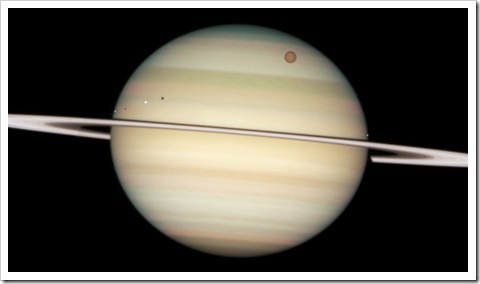
Ah, moons. So often overshadowed by your rocky, gassy, and thermonuclear overlords, you help invoke tides, stabilize axial tilts, sculpt and replenish rings, and provide at least one species with a stepping stone to timidly venture from the safety of their home planet. In this article we pay tribute to all those underappreciated planetary custodians by recognizing five of the downright weirdest moons in the solar system.
(more…)
Posted in Astronomy, Awesome | 3 Comments »
Monday, June 15th, 2009
Space.com posted an article last week about a boy being hit in the hand with a meteorite. Since then the online community has been abuzz, some excited, some crying fraud.
The details of the event itself are sketchy and vague, though the meteorite reportedly left a scar on the boy’s hand before drilling a crater into the ground. We talked to Astronomer Phil Plait about the incident. He gives a great breakdown of the case on his website Bad Astronomy.
Us: So do you think it is at all likely that the kid was hit with a meteorite?
Phil: It’s possible, but there are too many holes in the story. I’m pretty suspicious of this for the obvious reasons — it’s pretty unlikely — but a lot of the story doesn’t add up. He was on his way to school on what’s obviously a suburban street, but no one else saw the flash, the bang, him getting hit? Plus, the Telegraph article misquotes the scientist, so it seems like this is less and less likely the more and more I look at it.”
The Bad astronomer alerted us to the existence of photographs of the boy, crater and meteorite on a German Newspaper’s website. He believes that the impact crater in the photo is probably a fake.
But if confirmed, this incident will be one of the only known direct meteorite strikes that has occurred since Ann Hodges was struck with a grapefruit size meteorite in 1954, the first known incident in human history. We aren’t holding our breaths just yet.
Posted in Astronomy, Space, Space Objects | Comments Off on Meteorite Strikes Boy’s Hand
Tuesday, June 9th, 2009
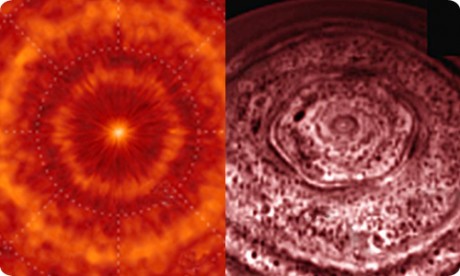
Saturn’s North Pole (Cassini-Huygens, 2007 and 2008)
In November 1980, planetary scientists eagerly examined transmissions received from the Voyager 1 spacecraft as it sped past Saturn. And with good reason! Amid those transmissions was the first image of Saturn’s North Pole – a region that’s virtually impossible to see from Earth, and, depending on the degree by which Saturn is tilted, can be cloaked in darkness for up to 15 years at a time (and you thought your last winter was never going to end).
What those scientists saw, and later missions confirmed, was a decidedly bizarre feature in the gas giant’s atmosphere directly above the North Pole: a 15,000-mile-wide hexagon.
(more…)
Posted in Astronomy, Feature stories, NASA, Physics, Space | 7 Comments »
Friday, May 8th, 2009
A five-part series that tries to explain how to make the science of Star Trek real…
Probably the most fascinating idea that Star Trek popularized was the idea of a warp drive. This was a concept from golden age sci-fi that went mainstream via Trek as space-age audiences became sophisticated enough to realize that NASA’s fastest rockets wouldn’t take you very far in a human lifetime. Even going the speed of light wouldn’t work for a show that tried to visit more than one star system in it’s 3 season run (due to time dilation your characters could visit those places, but their friends back on earth would be long dead). What was needed was a (plot) device that allowed you to visit distant planets in the time it takes to drive to the next state.
Since Star Trek, warp drive has become a part of public consciousness. It’s a theoretical form of technology that some feel is as inevitable as AI and teleportation.
There’s one big catch; while AI (or something that acts like it) seems to be a problem solved at some point on a graph projecting the development of intelligent systems and teleportation seems to be more of an energy problem, there’s not a viable theory for how a warp drive could work (exotic matter, worm holes, Alcubierre drives etc.) that doesn’t violate the laws of physics (as we know them) or result in some equation balancing phenomenon like a “quantum scream” (an obscure term used in an equally obscure paper on the subject).
(more…)
Posted in Astronomy, Feature stories, Higher Dimensions, movies, NASA, Physics, Science, Star Trek, TV, Weird Physics, Weird Space | 7 Comments »
Monday, March 30th, 2009
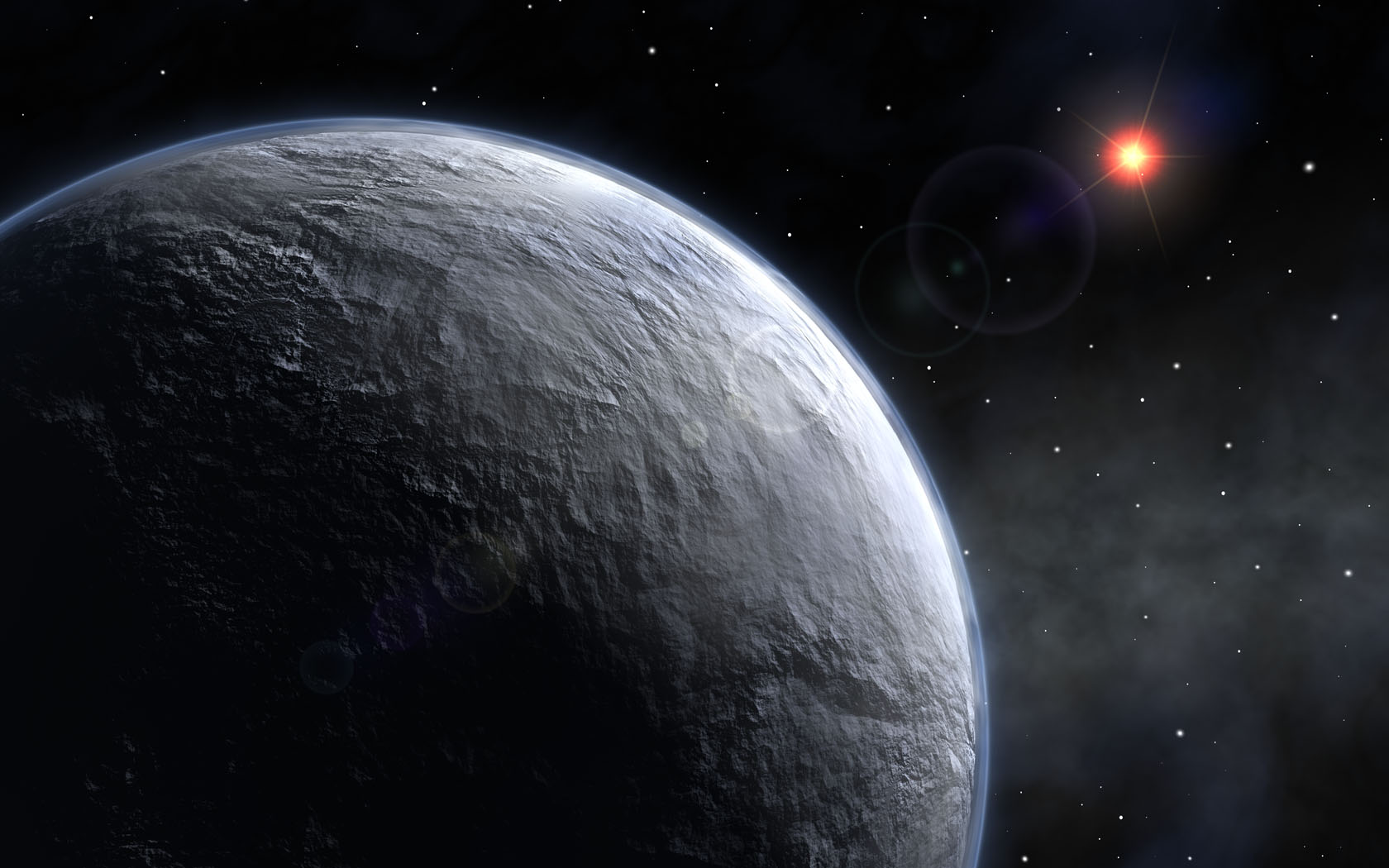
Astronomers have identified two massive balls of ice, orbiting a dwarf planet on the fringe of our solar system. According to sciencenews.org:
You’d need a mighty tall glass to hold two space objects that researchers have now identified as ice cubes at the fringes of the solar system. The larger of the icy bodies is about the width of Ohio, the smaller about twice the length of Rhode Island. Both bodies are moons of the dwarf planet Haumea.
Now that’s a lot of ice. It’s nice to know that when we finally get around to colonizing the solar system that there will be no shortage of fresh water to be harvested from these two ice spheres and space objects like them.
Posted in Animals, Astronomy, Space, Space Objects | Comments Off on Iceballs From Outer Space!