Saturn’s Persistent Hexagon
Posted by Editor on June 9th, 2009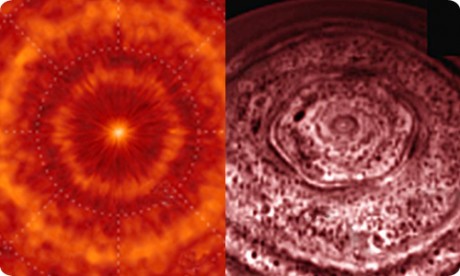
Saturn’s North Pole (Cassini-Huygens, 2007 and 2008)
In November 1980, planetary scientists eagerly examined transmissions received from the Voyager 1 spacecraft as it sped past Saturn. And with good reason! Amid those transmissions was the first image of Saturn’s North Pole – a region that’s virtually impossible to see from Earth, and, depending on the degree by which Saturn is tilted, can be cloaked in darkness for up to 15 years at a time (and you thought your last winter was never going to end).
What those scientists saw, and later missions confirmed, was a decidedly bizarre feature in the gas giant’s atmosphere directly above the North Pole: a 15,000-mile-wide hexagon.
At this point, before we lose all but Weird Thing’s distinguished geometry geek readership (you know who you are, you magnificent bastards), it’s worth pointing out that hexagons naturally occur all over the place: basalt columns; beehive honeycombs; snowflakes; and even molecules offer some examples. Unfortunately the processes responsible for these formations by no means explain the feature on Saturn. In fact, the planet’s thick atmosphere is one of the last places experts were prepared to find such a geometric oddity – even its South Pole has a reassuringly circular, terrifyingly enormous hurricane churning up the clouds.
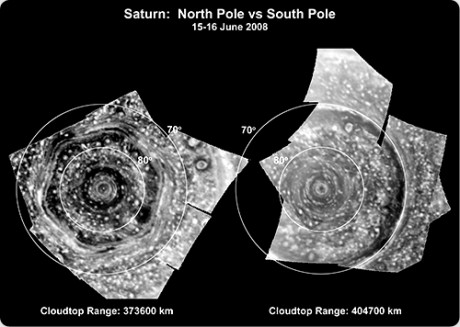
A Comparison of Saturn’s Poles (Cassini-Huygens, 2008)
So why is it there? Besides dropping Jodie Foster – or, ideally, Matthew McConaughey – into the middle of the 60-mile-deep hexagon and seeing where she goes, a slightly less exciting experiment conducted by the Niels Bohr Institute in Denmark provided some intriguing results. And by slightly less exciting, we mean they stirred a bucket of water. What they found was that at certain speeds the water flow would interact with the edges of the cylindrical container to create rotating polygons with up to 6 corners.
As you may have already guessed, the experiment has a long way to go before it explains Saturn’s hexagon. For one thing, a colossal bucket isn’t sitting at the North Pole to provide distinct boundaries for the planet’s many complex layers of clouds to interact. Scientists have yet to figure out precisely how Saturn is creating a similar result with its multifaceted toolkit of jet streams and waves. Perhaps a more relevant explanation may be found in satellite observations of Hurricane Isabel (PDF) from 2003, wherein the storm’s eyewall alternated between pentagonal and hexagonal formations through unique combinations of smaller rotational features called mesovortices; showing us that even home grown storms can test and inevitably improve our equations of motion.
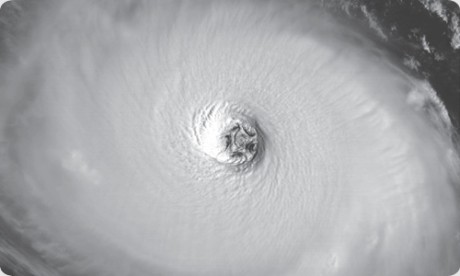
Satellite Observations of Hurricane Isabel in 2003 (PDF)
We’ll probably have plenty of time to figure out Saturn’s hexagon though. One of the most profound mysteries surrounding the formation (second only to its existence in the first place) is that it has stuck around as a stable feature in the 29 years or so since Voyager first observed it. As Saturn is currently in the unhurried process of tilting its North Pole towards the sun, scientists can soon point the Cassini-Huygens spacecraft’s superior optical instruments at the newly illuminated region to assist the relentless effort to discover answers (or more questions). Until then, we hope you’ll join us in simply appreciating this hexagon as one of the many weird things that makes our universe even more fascinating.
 Twitter this
June 28th, 2009 at 7:22 am
This is the best explanation of the hexagonal shape found at Saturns north pole the tie in to Hurricane Isabel sheds new light on the phenomena-will subscribe to the RSS have you checked out ping.fm -cool tool.
June 28th, 2009 at 3:42 pm
What a useful post here. Very informative for me..TQ friends…
Cheers,
jana duit
June 30th, 2009 at 5:27 am
I've seen this information before but always thought it was just an issue with the photography. I've seen enough reputable sources saying it isn't an artefact of the method of photography to stop thinking that, though. I've also seen people try to explain it but this is the first explanation that's actually made any sense.
July 31st, 2009 at 12:39 pm
How many years from now,will we know more about this?
Will the Casinni probe be imaging this again? In a
later orbit?
Thanks
Joe.
December 13th, 2009 at 2:03 am
i read somewhere that cassini mission have a backdoor in software and hardware and this might be product of a group of hackers.
the images are well photoshoped to look more dramatic.
they would call this the joke of the millenium.
December 16th, 2009 at 1:19 am
an intriguing phenomena … first thing that came to mind of course was the alignment of Saturn's north pole and its magnetic pole … they are within one degree which is quite unusual in our solar system … so my mind turned to a magnetic cause … and a little search came across an interesting piece of research which stated “We have also fabricated triangle shaped junctions and obtained the magnetic field dependence of Josephson current, where sub peaks can be observed in six directions at 0, 60, 120, 180 240
and 300 degree around the centre of the (Hx,Hy) magnetic plane. This magnetic dependence has hexagonal symmetry.” the photos of the experimental results bear an uncanny resemblance to some of the photos on the NASA site …. the main difference would be that Saturn is spinning on its pole while the experimental photos would be for a stationary system …. an abstract of the article can be found at http://www.iop.org/EJ/article/1742-6596/43/1/26… ….
December 16th, 2009 at 7:19 am
an intriguing phenomena … first thing that came to mind of course was the alignment of Saturn's north pole and its magnetic pole … they are within one degree which is quite unusual in our solar system … so my mind turned to a magnetic cause … and a little search came across an interesting piece of research which stated “We have also fabricated triangle shaped junctions and obtained the magnetic field dependence of Josephson current, where sub peaks can be observed in six directions at 0, 60, 120, 180 240
and 300 degree around the centre of the (Hx,Hy) magnetic plane. This magnetic dependence has hexagonal symmetry.” the photos of the experimental results bear an uncanny resemblance to some of the photos on the NASA site …. the main difference would be that Saturn is spinning on its pole while the experimental photos would be for a stationary system …. an abstract of the article can be found at http://www.iop.org/EJ/article/1742-6596/43/1/26… ….